
Customer
Killing drug targets early: how Apoptosis AI won the London hackathon
Two winning teams from the London "Building an AI Scientist" hackathon built on the Amass Cores, and both were still building on them more than a month later. Here is what they built and why they reached for a curated, linked data instead of a search tool.
- Customer
- API
- Use Case
Killing drug targets early
A drug program behind a target that fails in Phase 2 has already absorbed years of work and often hundreds of millions of dollars. The evidence that it was the wrong target was frequently sitting in the literature the whole time.
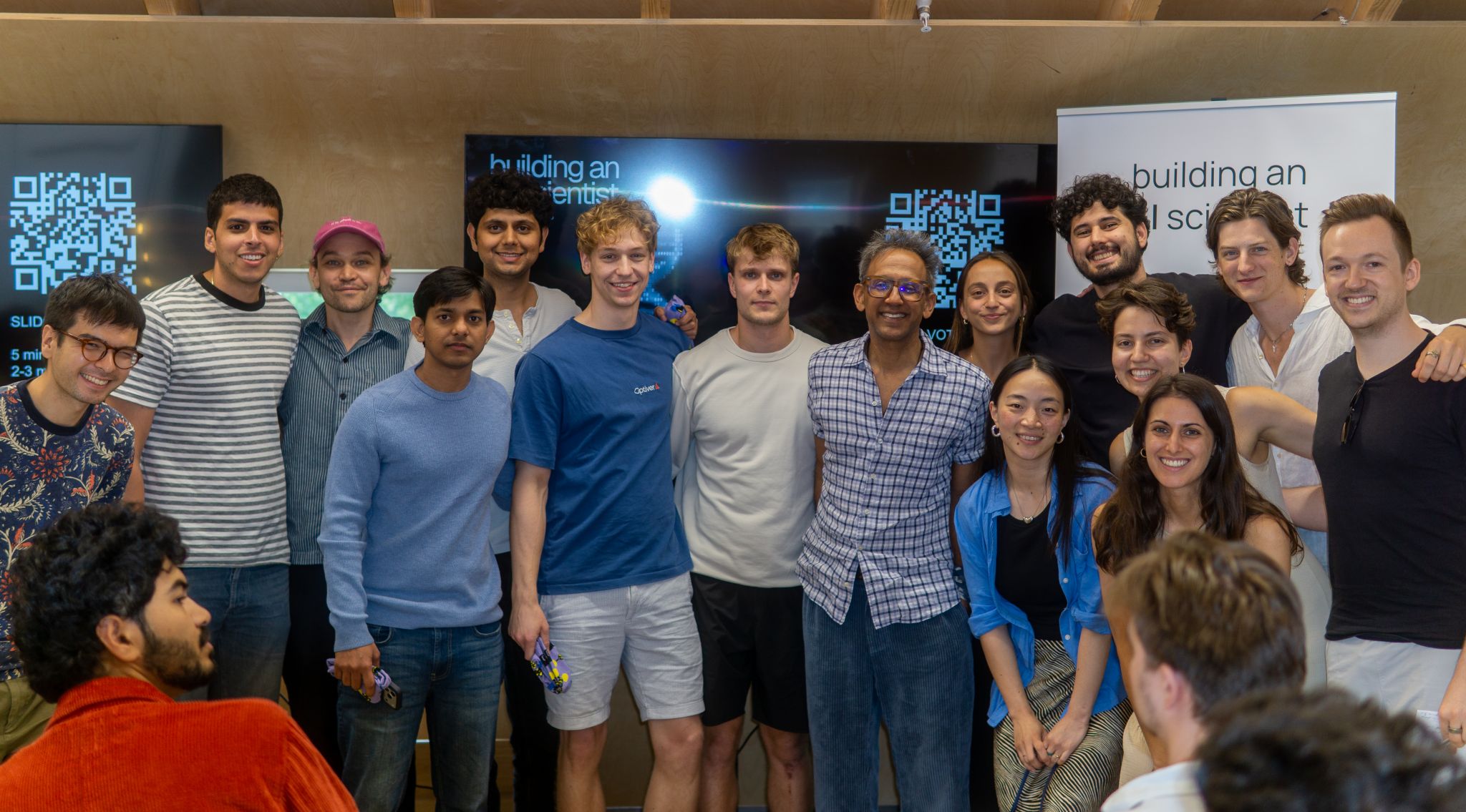
At Building an AI Scientist in London, 70 people across 15 teams spent three days in July building tools to close that gap. The two winning teams (and many others) built on the Amass Cores. Apoptosis AI took first prize with a system that helps pharma kill targets before Phase 2. Druggabilitome took the o2h Discovery prize with a framework that inverts the discovery funnel entirely.
This is how they built, in their own words.
Apoptosis AI: killing targets before Phase 2
Six people, two of whom decided to enter three days before the event, built an agent system to catch bad targets early and won first prize. We sat down with Jan Boltersdorf and Janik Ludwig to hear how it works.
The problem they picked
Janik puts the thesis plainly.
"We built a tool that helps pharma kill drug targets early in the pipeline, before they go into clinical Phase 2 trials, before they fail. If everything works, we avoid pharma going in the wrong direction for a couple of years and spending millions to billions on research."
Janik Ludwig, Apoptosis AI
The framing cuts both ways. The same assessment that kills a bad target tells you when a good one is worth committing to.
The part that makes it usable is not the verdict, though. It is what comes with it.
"The most important thing about the tool is that we suggest the highest impact experiments that bring you closer to a decision."
Janik Ludwig, Apoptosis AI
The output is not a score you have to trust. It is the next thing to go and measure. In the demo, the target on screen was a transcription factor implicated in non-alcoholic fatty liver disease, and Janik had already run the suggested experiment past a researcher building a company around that target. She confirmed it was an experiment she was actually running in her lab.
The team
The team was Youssef Abdalla, Dmitry Kalupin, Janik Ludwig, Jan Boltersdorf, Axay Soni and Gopalkrishna Purohit. Between them they brought two software engineers, a molecular biologist, a computational bioengineer, a pharmacist working in machine learning, and a mathematician.
Janik credits that spread directly for the win. An "insanely interdisciplinary team" meant the work split cleanly the moment they started. Architecture and integration went to the engineers, agent design to the people with the biology, and product framing to those who had built companies before.
How it works
Apoptosis AI is a set of scientific agents behind an orchestration layer that keeps their inputs and outputs straight, feeding a report builder.
The gap-analysis agent is the one that keeps the system honest. Rather than only reporting what the evidence supports, it names the weak spots across biology, patentability and safety, meaning the places where the case for a target is thin.
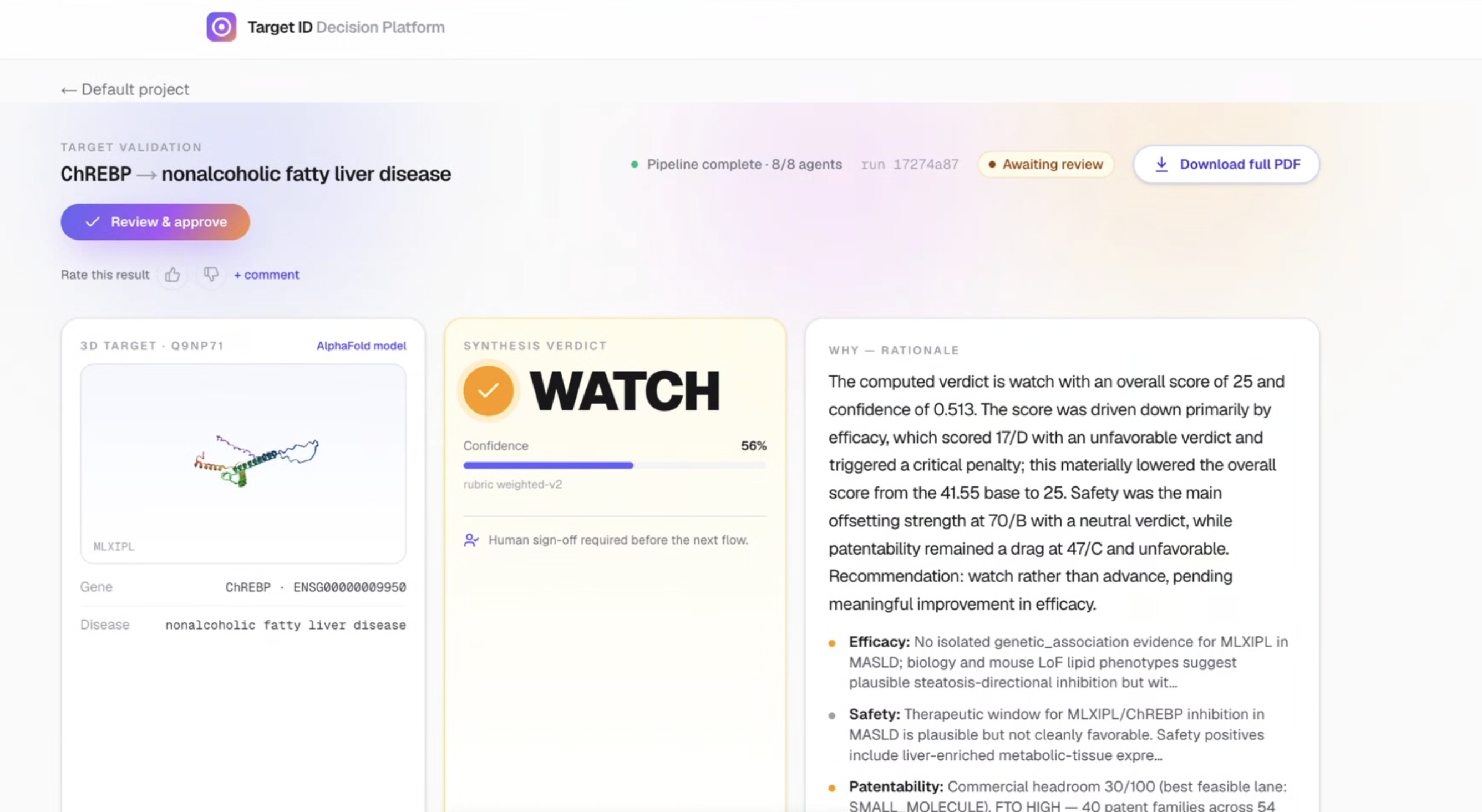
Every claim in the report is citation linked, and users can upload their own experimental data alongside it.
Where Amass came in
The team built on the Amass Cores through the API. Here is where each one landed, and then the use we did not see coming.
| Core | What it answered |
|---|---|
| GeneCore | It resolved a clean identifier for the gene in its disease context. Combined with Open Targets, it established the gene–disease association and ran redundancy checks against population-level and knockout studies. |
| DrugCore | Has this target already been drugged? The team works on novel targets, but as Jan puts it, "you got to do the double check anyway." |
| BioMedCore | The published evidence behind the gene–disease case. Papers, abstracts and citation trails, so that every claim in the report resolves to a source rather than to model recall. |
| TrialCore | Has anyone taken this target into the clinic, and what happened there? Phase, status and outcomes give the biological assessment a read on precedent and on prior failure. |
| Across Cores | GeneCore and DrugCore were also wired into the patentability agent, and more lightly into the safety agent. |
The use we did not see coming
Target assessment has an awkward hole in it. You are evaluating a target, so there is no compound yet. How do you say anything about efficacy when there is no drug to be efficacious?
Jan's answer was to approximate it structurally. He takes the protein and walks outward from it in two independent directions.
- By family. Locate the protein in its structural family, then build a neighbour list.
- By structure. Find structurally similar proteins.
That produces a neighbour list, which he then checks against DrugCore. Has anything structurally similar to this target ever been successfully drugged?
Two independent routes out from the target, with one curated database as the arbiter. It is a genuinely good idea, and it is not a use we had made the Cores for. It fell out of the links between them.
"This is, I think, the coolest thing of how we use Amass."
Jan Boltersdorf, Apoptosis AI
Why a curated database and not a search tool
This is the part of the conversation we keep coming back to.
Jan had the obvious alternative available. He could have pointed an agent at the literature and let it synthesise a review. He rejected it, and his reason is the clearest articulation we have heard of why the substrate matters.
"I could also use some kind of search tool, like a review literature synthesis. But I don't have this clear ground truth checkup that I have if I'm using a curated database. […] I'm trying to avoid hallucinations and just have a higher confidence if I have the availability of an actual curated database."
Jan Boltersdorf, Apoptosis AI
That is the whole argument for building agents on structured, harmonised data rather than on retrieval alone. It was made by someone who was building the thing, not by us.
What they are building next
The near-term plan is the unglamorous one. Get letters of intent, find out whether the idea is worth pursuing at all, and pick one or two diseases to be genuinely good at before widening.
The technical ambition is bigger. Jan wants to move Apoptosis AI beyond orchestrating other people's data and start generating its own, and he is clear-eyed about why that is hard. There is very little data on experimental predictions specifically. What does exist is skewed, because in his words "you only have positive results mostly." The labelling and reweighting problem therefore comes before the modelling problem.
Beyond that, Janik describes a pipeline that keeps going past validation. Once a target holds up, you design a binder against it, which tools like Boltz-2 have made "relatively easy," and then you optimise that binder with machine learning for protein engineering. The end state is not a service tool. It is running their own targets.
That is ambitious for a team that decided to enter three days before the hackathon. Then again, so was winning it.
Druggabilitome: inverting the funnel
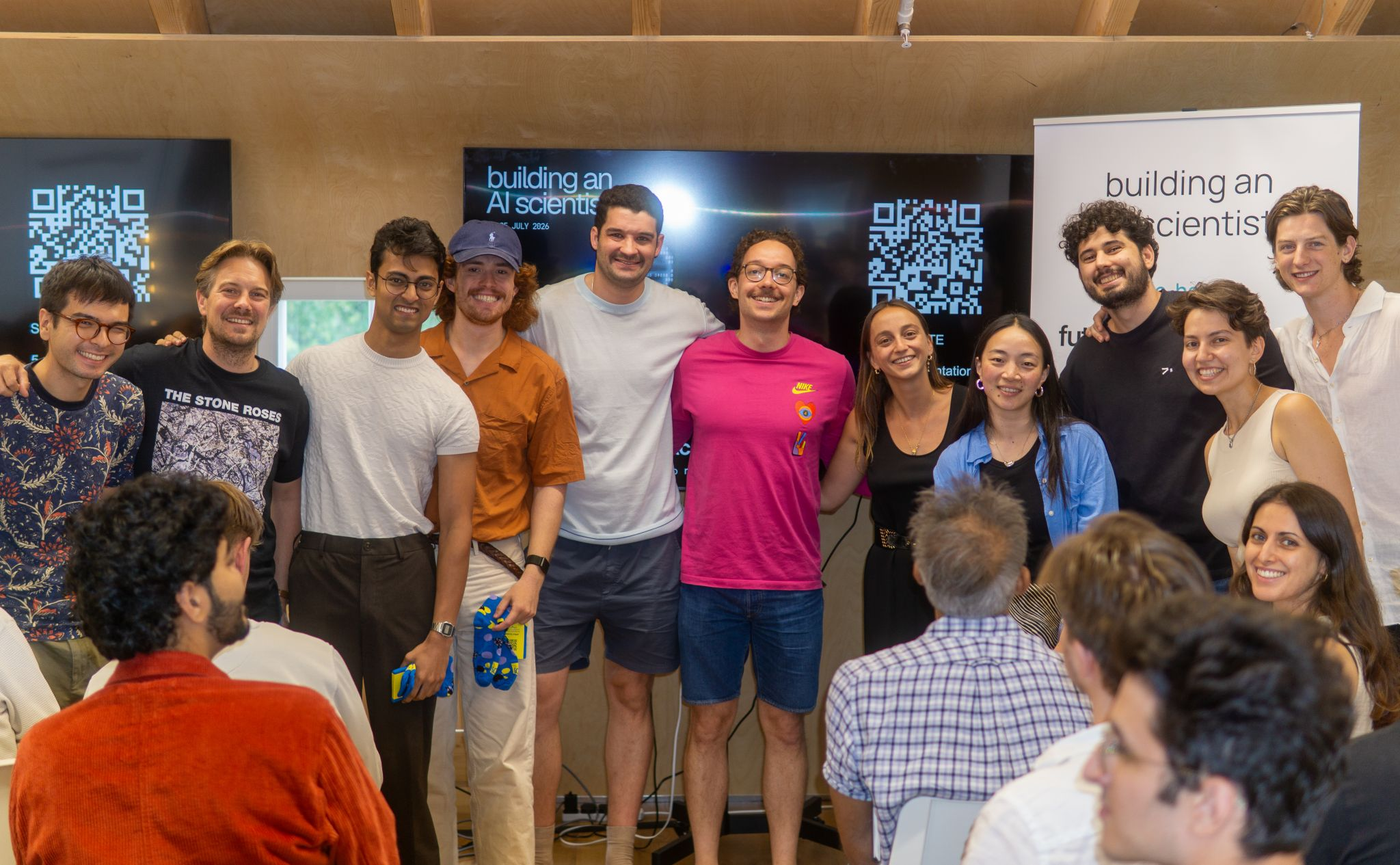
The o2h Discovery prize went to Jakub Lála, Harsh Agrawal, Wojtek Treyde and Murray Cox. Three of them are PhD students and one is an incoming AI for Science fellow at Oxford. They took the opposite run at the same problem. Instead of assessing one target at a time, they tried to assess the whole proteome at once.
The idea
In their own words:
"Our idea started with a simple question: why do we search for new drugs one target at a time? Early-stage drug discovery is slow, expensive and highly sequential. Each target is typically evaluated in isolation, so promising opportunities can be missed before they ever reach the lab."
The Druggabilitome team
Over the weekend they built a prototype of what they call the Druggabilitome, a framework that combines large-scale binder generation with AI-driven functional evaluation to identify promising protein–binder pairs across the proteome. Instead of treating target discovery, hit identification and early validation as three separate stages, they explored how those steps could be collapsed into a single scalable workflow. The long-term vision is to unlock new binding sites on known targets, and eventually entirely new therapeutic targets.
Where Amass came in
The bottleneck was not the part most people assume.
"Binder generation was never the bottleneck; interpretation was. We could co-fold binders against a target with Boltz, but a co-folding score on its own says nothing about whether a site is already well covered in the literature, whether the target is tractable, or whether the chemistry around it is already claimed. That context is exactly what we used Amass for."
The Druggabilitome team
For each target they pulled an Amass dossier and used it as the target-intelligence layer of the atlas: domain architecture, known binding sites and epitopes, tractability, genetic constraint, patent landscape and key references. That let them do two things they could not have done by hand in a weekend.
Classify hotspots as literature or new. Amass gave them the prior baseline for each target, so a Boltz-generated binder landing on a site could be labelled either as recapitulating a described pocket or as genuinely unreported. In their words, "that distinction is the whole point of the Druggabilitome. Without it, every hit looks equally novel."
Triage targets. The same dossier fields told them which targets were worth the compute in the first place. Tractability, genetic constraint and how crowded the surrounding patent landscape already was all fed the ranking, so the expensive generation step ran where it had the best chance of returning something new.
What they built after the hackathon
The version they demoed to us three weeks later is narrower and considerably more useful. For every protein target with at least one approved drug, they ask a single question. Does the literature agree with the crystal structure about where the drug actually binds?
They derive a structural epitope from the Protein Data Bank using a 5 Å contact cutoff, then cross-check it against non-structural wet-lab evidence surfaced from the literature by agents, including SPR, alanine scanning and functional scans.
The disagreements are the output. They found residues that the literature calls hotspots whose nearest contact measures 7 Å, which puts them outside the epitope entirely. The plan is to validate the workflow on targets where a crystal structure settles the answer, then run the same workflow on targets that have no structure at all.
They used all four Cores available to them for this, meaning BioMedCore, DrugCore, GeneCore and RegulatoryCore, and BioMedCore was the most valuable of the four. It surfaced epitope annotations and hotspot evidence that were, in Harsh Agrawal's words, "not present in structural database like UniProt." That is the clearest example we have of literature-derived annotation the structured sources simply do not carry.
The workflow itself is worth noting. They built a Claude workflow that pairs a direct search with an adversarial verification pass, both hitting Amass, and flags the cases where the two disagree. Nobody suggested that to them.
What is next
Their bottleneck is not software. It is wet-lab time. The o2h Discovery prize came with access to experimental validation support in Cambridge, and the shape of the next phase depends on what that validation can cover.
"Bringing together researchers, engineers, founders and mentors created an environment where ambitious ideas could quickly become working prototypes."
The Druggabilitome team
What repeats
Two teams, two different problems, one pattern.
Both reached for a curated, linked substrate rather than a literature-search tool, and both did it for the same reason. They needed a ground truth their agents could be checked against. Jan said so directly. The Druggabilitome team arrived at it from the other end, because they needed the prior art on a site before they could call a hit novel.
Both found uses we had not marketed. One team built a structural-similarity route to potential efficacy. The other pulled literature-derived epitope evidence that the structural databases do not hold. Neither use came from a single Core. Both fell out of the links between them.
And both built an adversarial check into the loop. Apoptosis AI has a gap-analysis agent that names where the case for a target is thin. Druggabilitome runs a verification pass against the same data and reports the disagreements. Neither team was asked to do that.
That is the repeatable part. Give a team clean, cross-linked biomedical data through an API, and the good ones will use it as a referee rather than as a source.
About the hackathon
Building an AI Scientist ran from 3 to 5 July 2026 at 50Y in Soho Square, London, and brought together 70 participants across 15 teams. It was co-hosted by TernaryTx, future.bio, Pluto House and Anthropic.
It was supported by a group of partners working to accelerate innovation in AI and biotech, including Anthropic, Daphni, redalpine, AWS, Boltz, 50Y, ARIA, Amass, Elicit and o2h technology.
Building on the Cores
Neither of these teams used the Cores the way we would have demonstrated them. That is the useful part. The Cores are a substrate, and what gets built on a substrate is not something the people maintaining it get to decide in advance.
"What we are proudest of is not that these teams used Amass over the hackathon weekend. It is that they are still building on the Cores more than a month later, on work that has moved well past what they demoed in London. Two independent teams reached for the same layer and kept relying on it long after the prizes were handed out. That is the clearest signal we have that the Cores are doing real work for the people who build on them, and it is not something a weekend can tell you."
Alexander Junge, Co-Founder and CTO, Amass
If you are building agents that need biomedical data underneath them, we would rather hear what you are trying to do than pitch you.
Book a technical discussion