
Use Case
CDH17 at AACR and ASCO 2026: 26 molecules and one journal paper with patients
BiomedCore now includes conference abstracts. For CDH17, the AACR and ASCO 2026 abstracts list 26 molecules, and the journals hold one paper with patients.
- Use Case
- Product
At AACR and ASCO 2026, two of the world's leading cancer conferences, 26 molecules aimed at CDH17 (cadherin-17) were presented, and TrialCore lists 24 registered trials of CDH17-directed products. The 26 include antibody-drug conjugates (ADCs), bispecific ADCs, T-cell engagers, trispecifics, a CAR-T, 4-1BB agonists and a radioligand. CDH17 is a surface protein of the intestinal lining that most colorectal cancers overexpress.
TL;DR
- BiomedCore now holds 2.5 million conference abstracts. It also holds 41 million journal articles, and one search returns both.
- Beyond a articles search, conference abstracts show trial and drug data about seven months earlier. In 150 trials named in conference abstracts, the abstract came a median 214 days before the first journal article where one followed.
- The abstracts are integrated with the Amass Cores through the API, the MCP server and the Amass app.
- For CDH17, the journals hold 13 research papers and one reports patients, while the abstracts and the registry show 26 molecules and 24 trials. Two molecules have first-in-human data that no journal has, and findings on drug clearance and payload resistance appear in the abstracts and only in part in the journals.
What the abstracts and the registry show
Journal coverage of the 26 molecules
Of the 26 molecules, 18 have a name we could search for, and 17 of those appear in no journal title or abstract. The exception is IBI3019, whose preclinical paper appeared in Cancer Research this month. The 26 span nine modality classes, including seven ADCs, five bispecific ADCs and four trispecific T-cell engagers.
ADCs shown at AACR 2025
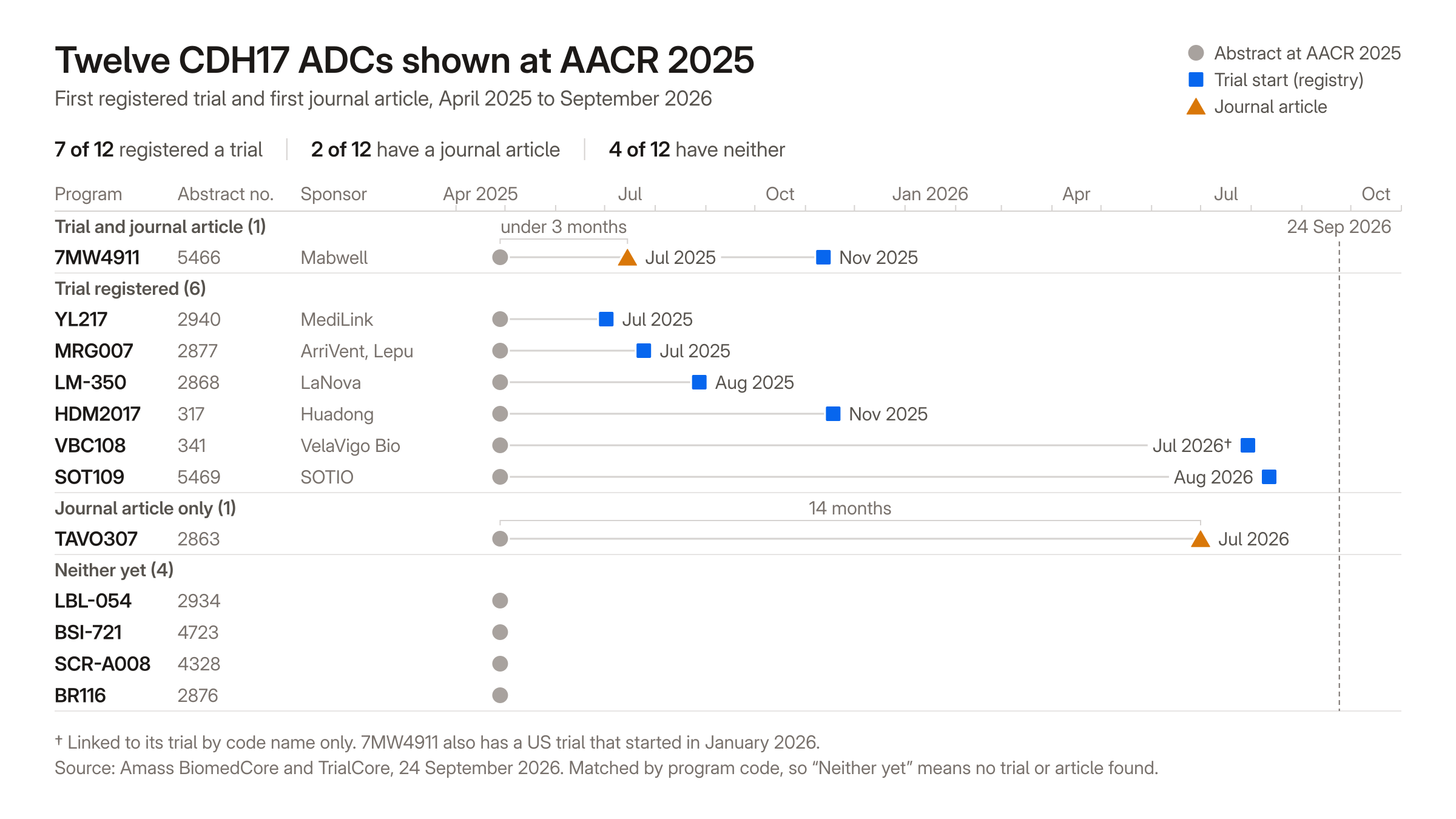
Seven of the 12 CDH17 ADCs shown at AACR 2025 have registered a clinical trial in the 17 months since, with start dates from July 2025 to August 2026, in line with a typical one- to two-year path from a preclinical poster to a first-in-human trial. Two have reached a journal, 7MW4911 in under three months (Cell Reports Medicine) and TAVO307 in fourteen (Antibody Therapeutics), and four have neither. Our reading: after 17 months, no trial and no paper is a weak signal that a program was discontinued or deprioritized, not that it is quietly still in development.
Mabwell, MediLink and LaNova each presented one of the 12 at AACR 2025, have recruiting trials, and have no CDH17 abstract at the 2026 meetings we searched. Our reading: once a trial opens, sponsors often move from preclinical posters to running the trial, so their absence from the 2026 meetings is not itself a signal of trouble. Of the 12, only LBL-054 has a CDH17 abstract at those meetings, as a T-cell engager drug conjugate (AACR 2026, 5857).
First-in-human data
Two first-in-human readouts exist only as abstracts, both presented at ASCO 2026, and neither reports objective responses.
- Cabotamig (CDH17×CD3 T-cell engager, Arbele) treated 22 patients across seven dose cohorts. Cytokine release syndrome rose with dose, a split first dose appeared to mitigate it, and the abstract interprets the lack of persistent GI toxicity as minimal on-target effect on normal mucosa. The data cutoff is February 2025, fifteen months before the meeting. TrialCore lists the trial as completed in July 2025 with 33 patients enrolled, and no journal article names cabotamig or its earlier code ARB202.
- CHM-2101 (CDH17 CAR-T, Chimeric Therapeutics) treated nine patients with no dose-limiting toxicity, one grade 3 CRS and one grade 3 enterocolitis.
BI 905711, abstract and paper
The ASCO GI abstract of January 2023 described "early signs of disease control" for BI 905711, Boehringer Ingelheim's TRAILR2/CDH17 bispecific, and the paper published more than three years later concludes "limited clinical activity". The abstract reported 13 patients with stable disease in an interim cohort of 48. The paper, in the May 2026 issue of Cancer Research Communications, reports 110 patients on monotherapy, with stable disease in 22.1% of the 104 response-evaluable.
Technical findings in the abstracts
On-target toxicity in the gut is the main concern for every CDH17 program, because CDH17 is also expressed on normal intestinal epithelium. The argument for targeting it is that healthy tissue restricts CDH17 to the lateral membrane behind tight junctions, where antibodies and T cells reach it poorly, and that tumors lose this polarity. Penn proposed this in 2022, and four of this year's abstracts use it as their rationale.
Target-mediated clearance in the gut
Three abstracts report findings consistent with target-mediated clearance in the gut, and no journal title or abstract that names CDH17 uses the words "target-mediated" or "clearance sink".
- A UCLA abstract (AACR, 1323) suggests that normal colon and ileum may act as a clearance sink, "a pharmacokinetic challenge that may limit clinical utility". Two CDH17 ADCs, one with MMAE and one with exatecan, were dosed in mice that express human CDH17, and both were cleared from serum in under 96 hours. The antibodies do not bind mouse or rat CDH17, so ordinary xenograft models cannot show this effect.
- BHB810's abstract reports "on-target ADC accumulation with reduced plasma exposure".
- Cabotamig's abstract reports "faster-than-typical IgG4 clearance" in patients.
No abstract connects the three, and that link is our reading. Monkey studies of ARB1002, AMT-676 and Champions' CO-ADC-010 report favorable PK or no target-related toxicity, so the evidence is mixed.
Payload resistance and P-gp
In the same UCLA abstract, an exatecan ADC outperformed an MMAE ADC built on the same antibody in models with high P-glycoprotein (P-gp). Forcing P-gp expression in a CDH17-positive line made it resistant to the MMAE ADC while sensitivity to the exatecan ADC remained, and CRISPR knockdown of P-gp reversed the resistance. One journal paper, Mabwell's 7MW4911 in Cell Reports Medicine, also found a topoisomerase I payload outperforming MMAE and DXd in multidrug-resistant models. We found no journal article with the P-gp gain-and-loss experiments.
Nine of the 13 ADC-type molecules among the 26 use a topoisomerase I payload, two use MMAE and two name no payload. TORL-3-600, in phase 1 since September 2023, is an MMAE conjugate.
How we found it
We started from three recent oncology meetings and used counts to pick the target.
- We used the 25,180 abstracts of ASH 2025, AACR 2026 and ASCO 2026, three of the most recent major oncology meetings with full abstract text in BiomedCore.
- For every human gene named in those abstracts next to an engineered modality (ADC, bispecific, T-cell engager, CAR, degrader or radioligand), we counted the abstracts and, separately, the journal titles and abstracts in all of PubMed that pair the same gene and modality. 203 targets reached five abstracts.
- CDH17 had the highest ratio of abstracts to journal articles among targets with at least 20 abstracts, 28 abstracts against 20 journal articles. The 20 articles were reviews, pathology studies, preclinical work and one paper with patients.
- We read all 31 abstracts labeled AACR 2026 or ASCO 2026 that mention CDH17 (26 and 5), listed the 26 molecules and searched each name in journal titles and abstracts.
- We checked the result against TrialCore and PatentCore. The abstracts by themselves showed three clinical programs, while TrialCore lists 24 registered trials and PatentCore lists 28 organizations with CDH17-directed cancer-therapy applications published since January 2024, most of them without an abstract at these meetings.
What the abstracts can't tell you
- What the abstracts can't tell you is how robust a claim is. Sponsors or their founders write most of them, report a claim in a few hundred words without methods, and many results are in vitro or in mice. The clinical data are also small enough that one abstract cannot show whether an effect holds in a larger trial: 22 patients for cabotamig, nine for CHM-2101.
- Coverage is incomplete.
- We used three meetings, and meeting labels are umbrella labels: "ASCO 2026" includes the January GI symposium and "AACR 2026" includes AACR special conferences.
- ESMO abstracts are in BiomedCore by title only, so AMT-676's phase I readout at ESMO GI (July 2026) has no text to search.
- The registry and patent links are ours, and the counts are lower bounds. We tied trials to programs by product code and sponsor. The searches are semantic and capped, and PatentCore covers a subset of life-science patents, so a missing patent does not show that none exists.
- Counts depend on scope. 26 is our count of named or clearly distinct products. The count of 13 papers covers ADCs, bispecifics, T-cell engagers, CAR cell therapies and photoimmunotherapy; nanobody-guided immunotoxins, a 177Lu nanobody and bacterial and vesicle platforms would add about seven.
Running this comparison in BiomedCore
BiomedCore now holds 2.5 million conference abstracts and 41 million journal articles, and one search returns both. In the API, a conference abstract carries Conference in publicationTypes.
A search for CDH17 ADC target-mediated clearance returned one abstract and two journal papers in one list: the UCLA abstract first, then the AMT-676 journal paper, whose cynomolgus studies report favorable PK, then a 2013 paper that found the intestine to be a saturable antigen sink for an anti-TENB2 ADC in rodents.
- For a program lead, the abstracts list questions to check against the program's own data, such as whether the antibody binds the mouse ortholog and whether the payload is a P-gp substrate in a tumor type where P-gp is high.
- For business development, filing patents, dosing patients and presenting at meetings are separate signals that overlap only partly. YL217, MRG007 and LM-350 have recruiting trials and no clinical abstract.
- For an investor, most ADC programs share a payload class, one trial has reached phase 2, and no journal title or abstract that names CDH17 uses the term target-mediated clearance.
Outside CDH17, the conference abstract came a median 214 days before the first journal article where one followed, and 20.7% of the trials were named in no journal article at all (150 trials named in conference abstracts from September 2024 to September 2025).
To run the same comparison on your own target:
- Search BiomedCore for the target and for the mechanisms you are concerned about. Abstracts and papers come back in one list.
- Count which names appear in a journal article.
- Open TrialCore and PatentCore on the same target to see who is dosing patients and who is filing without presenting.
You can run the three steps in the Amass app, or connect the Amass MCP server to your own AI assistant and ask it to run them.
The full field list, filters and endpoints are in the BiomedCore docs. If you want this comparison for a target you follow, get in touch. We'd like to compare notes.
Sources
Conference abstracts
- ASCO 2026, cabotamig phase 1, 3603: 10.1200/jco.2026.44.16_suppl.3603
- ASCO 2026, CHM-2101 phase 1, 2536: 10.1200/jco.2026.44.16_suppl.2536
- ASCO GI 2026, ARB1002, 736: 10.1200/jco.2026.44.2_suppl.736
- ASCO GI 2023, BI 905711 phase Ia/b, 115: 10.1200/jco.2023.41.4_suppl.115
- AACR 2026, UCLA ADC payloads and clearance, 1323: 10.1158/1538-7445.am2026-1323
- AACR 2026, WuXi Biologics masked TCE, 1625: 10.1158/1538-7445.am2026-1625
- AACR 2026, ACR317, 1774: 10.1158/1538-7445.am2026-1774
- AACR 2026, Champions ADC and radioligand, 4543: 10.1158/1538-7445.am2026-4543
- AACR 2026, CASB trispecific, 5588: 10.1158/1538-7445.am2026-5588
- AACR 2026, LBL-054 TDC, 5857: 10.1158/1538-7445.am2026-5857
- AACR 2026, BHB810, 6922: 10.1158/1538-7445.am2026-6922
- ESMO GI 2026, AMT-676 phase I, 112P: 10.1016/j.annonc.2026.05.113
- AACR 2024, TORL-3-600, 1900: 10.1158/1538-7445.am2024-1900
- AACR 2025, the 12 CDH17 ADC abstracts: LBL-054 2934, LM-350 2868, VBC108 341, 7MW4911 5466, BSI-721 4723, SCR-A008 4328, MRG007 2877, YL217 2940, HDM2017 317, SOT109 5469, BR116 2876, TAVO307 2863
Journal articles
- BI 905711 phase I, Cancer Research Communications 2026: 10.1158/2767-9764.CRC-25-0638
- CDH17 CAR T cells, Nature Cancer 2022: 10.1038/s43018-022-00344-7
- 7MW4911, Cell Reports Medicine 2025: 10.1016/j.xcrm.2025.102213
- TAVO307, Antibody Therapeutics 2026: 10.1093/abt/tbag012
- AMT-676, Advanced Science 2026: 10.1002/advs.77521
- IBI3019, Cancer Research 2026: PMID 42678245
- TENB2 antigen sink, British Journal of Pharmacology 2013: 10.1111/j.1476-5381.2012.02138.x
Trials (24)
Cabotamig NCT05411133, CHM-2101 NCT06055439, DB-1324 NCT07263594, BI 905711 NCT04137289 and NCT05087992, TORL-3-600 NCT05948826, AMT-676 NCT06400485 and NCT07474727, 7MW4911 NCT07265622 and NCT07216560, YL217 NCT06859762, MRG007 NCT07066657 and NCT07737600, LM-350 NCT07112222, HDM2017 NCT07274085, NCT07621159 and NCT07805551, SOT109 NCT07693751, BHB810 NCT07529808, VBC108 NCT07700160, UCLH801 NCT06937567, 920th Hospital CAR-T NCT06820424, Shanghai Pudong Hospital CAR-T NCT06501183, and the withdrawn CDH17/GUCY2C CAR-T trial NCT07152210.
Book a technical discussion