
Customer
A source for every claim: how GenCite won the Scientific Discovery track in Vienna
GenCite turns a gene list into short claims, each citing the evidence behind it and checked twice. A team of two built it on Amass in 19.5 hours in Vienna.
- Customer
- API
- Use Case
Every gene list ends up on someone's desk
Almost every omics analysis ends with a gene list, and someone has to look up each gene by hand in PubMed, Open Targets or the Human Protein Atlas. For 15 to 50 genes, that takes hours to days. A language model answers faster and often gets the biology right, but its citations fail. When the GenCite team tested a plain model, 84% of the PubMed IDs it cited never mentioned the gene.
At HACK_002: Signal From Tomorrow in Vienna, 65 builders in 25 teams had 19.5 hours to build. GenCite shared the AI for Scientific Discovery prize with miRacle, and we spoke to Simon Chen and Lucia Ahcin about how they built it.
The problem
"In life sciences you often get a gene list as a result. […] That might be doable if you have 10 genes to look up, but if you have multiple gene lists from different data sets, from different populations, then that's just a lot of manual work."
Simon Chen, GenCite
Simon studied biology at the University of Vienna before moving into bioinformatics. He pitched the idea to Lucia, a bioinformatics master's student he found on the hackathon Discord.
How it works
Lucia built the retrieval half, which queries four sources and normalises their results into one evidence record per gene, with an ID on every item. Simon built the half that writes and checks the claims.
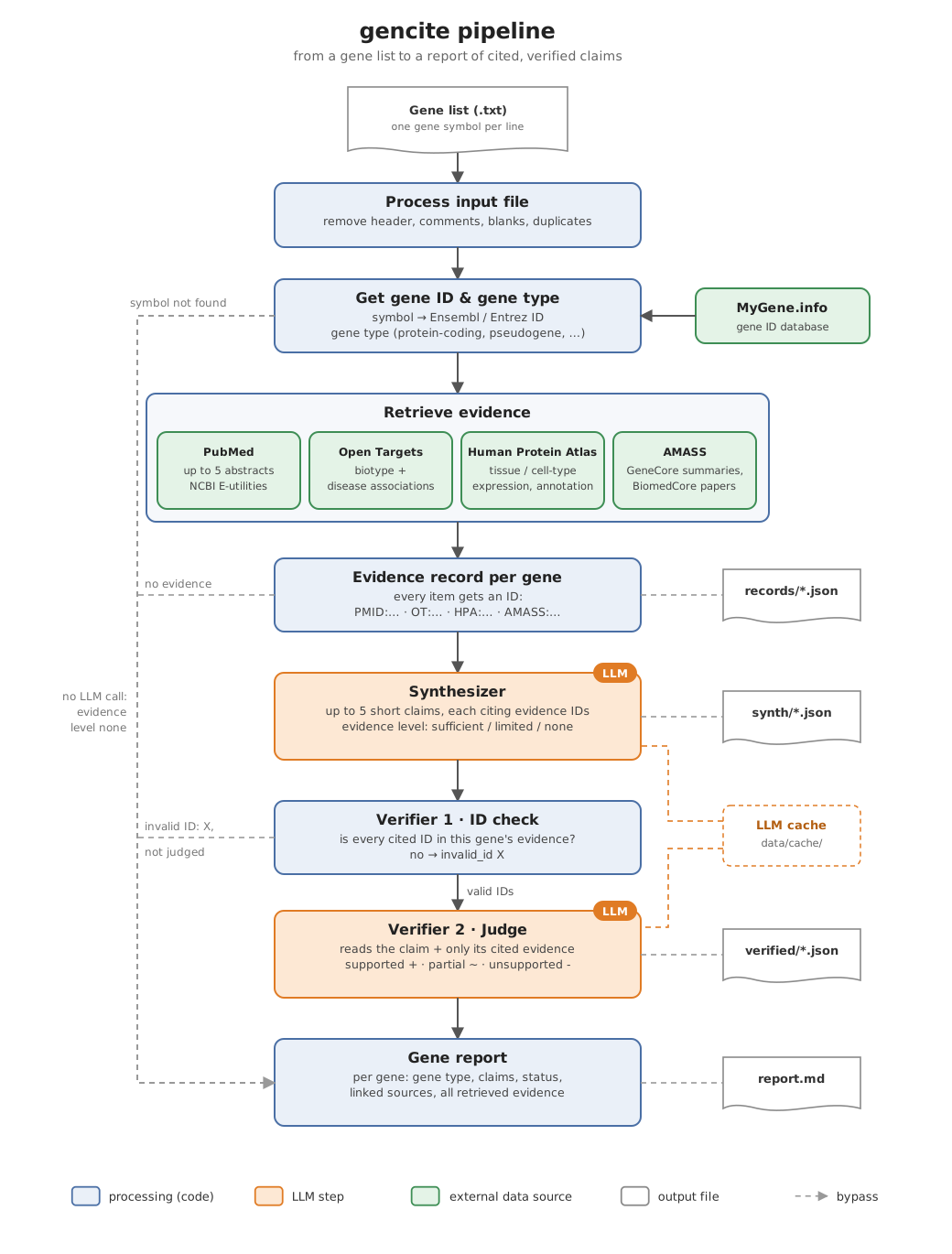
The model may only use the retrieved evidence, and each claim must cite the IDs it rests on. Plain code rejects any claim that cites an ID not retrieved for that gene. A second model call then reads each remaining claim against its cited evidence and rates it supported, partial or unsupported. Genes with no usable evidence get no claims.
Where Amass came in
The team had planned on PubMed and Open Targets and added Amass after it was presented at the start of the event.
"It seemed like something that could very naturally be used as something that we already planned, so it was very easy to integrate it."
Lucia Ahcin, GenCite
GenCite calls the Amass API directly. From GeneCore it takes the RefSeq gene summary, gene metadata and the UniProt protein annotation (function, associated diseases, tissue specificity, subcellular location). From BiomedCore it takes up to three relevant publications per gene, after its own relevance filter.
The baseline test
The team gave the same model (deepseek-chat) the same task without retrieval and checked both outputs the same way. The test set had five well-described genes and three negative controls: two pseudogenes and a symbol that does not exist.
"If we don't do the information retrieval and the judging, then the LLM does generate correct biological facts, but it will provide the wrong sources."
Simon Chen, GenCite
| Metric | GenCite | Same model, no retrieval |
|---|---|---|
| Cited PMIDs that never mention the gene | 0% (0/14) | 84% (16/19) |
| Claims supported by their cited source | 93% (25/27) | 0% (0/25) |
| Claims judged partial | 7% (2/27) | 16% (4/25) |
| Claims unsupported | 0% | 84% (21/25) |
| Well-described genes: expected biology mentioned | 5/5 | 5/5 |
The plain model knew the biology, and the papers it cited were real, but they were about something else. For ERAP2, for example, it cited a paper on ERAP1. A check for invented IDs would have passed the baseline, and the failure only showed once the judge read the cited abstract.
About the hackathon
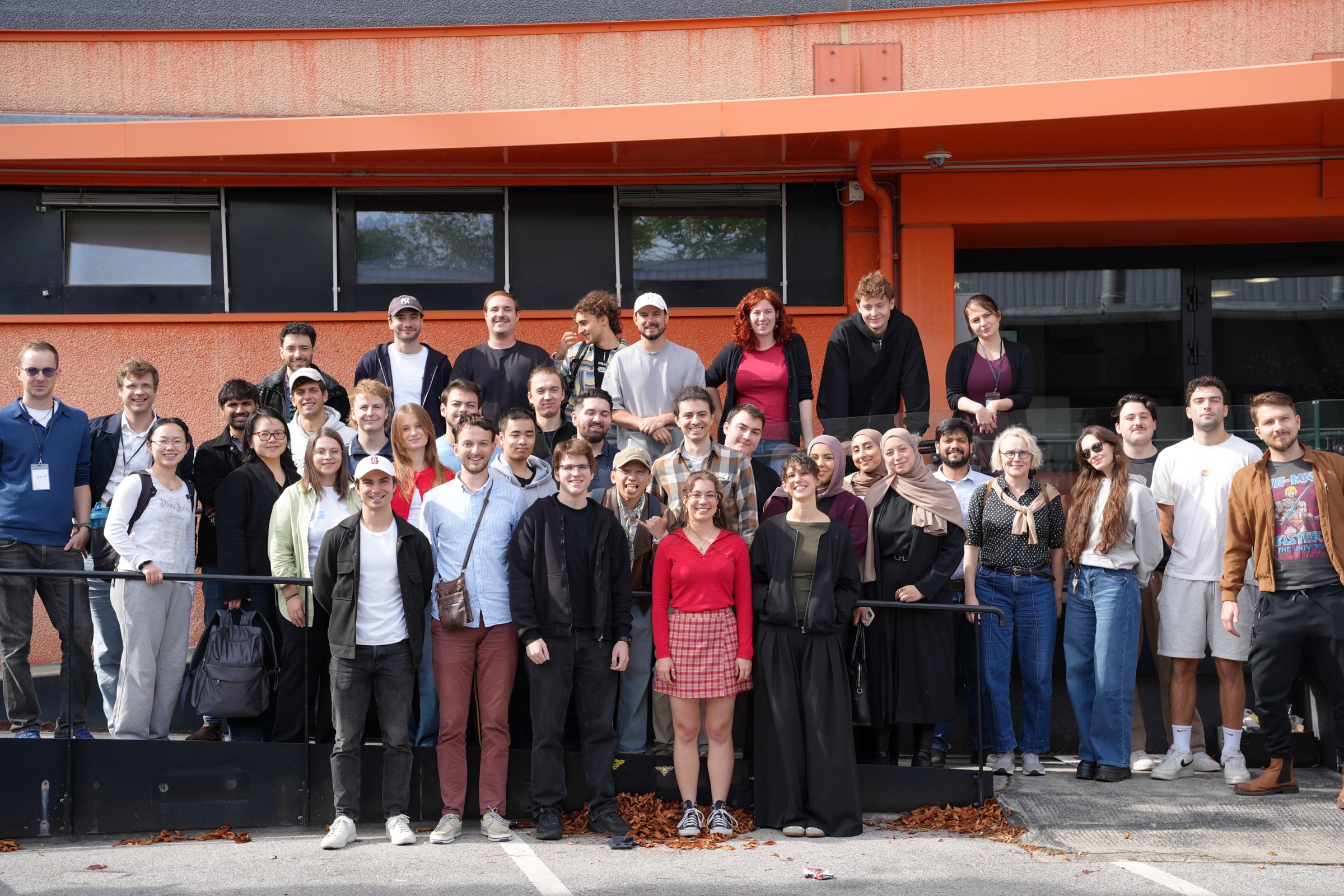
HACK_002: Signal From Tomorrow ran on 26 and 27 September 2026 at HOIV in Vienna, organised by Telos Circle. Amass gave every team $500 in API credits. Two winning projects were built on the API: GenCite, and Gina from pJacked, which won Applied AI for You. Full results are on the Telos Circle event page.
GenCite used two of the six Cores. If you are building something that has to cite its evidence, we would like to hear what it is.
Book a technical discussion