
Use Case
Safety Questions with and without Amass in Claude
We asked Claude for Keytruda's safety signals with and without the Amass connector. With Amass, the median source year was 2026 and it read the current label.
- Use Case
- Product
With the Amass connector, 12 of the 20 dated sources Claude cited on Keytruda's safety signals were from 2026. With web search alone, 2 of 13 were.
TL;DR
- Amass gave Claude newer sources. The median source year was 2026 with Amass and 2022 with web search.
- Amass gave Claude the current label in full. Claude opened the FDA label dated 20 October 2026 and the current EU SmPC, with full section text. The label versions it found through web search were dated 2017–2019 or undated.
- Amass found important evidence outside the label. It found post-marketing studies, trial terminations and real-world evidence, including three candidate signals not explicit in the label sections reviewed.
Median source year: 2026 with Amass, 2022 with web search
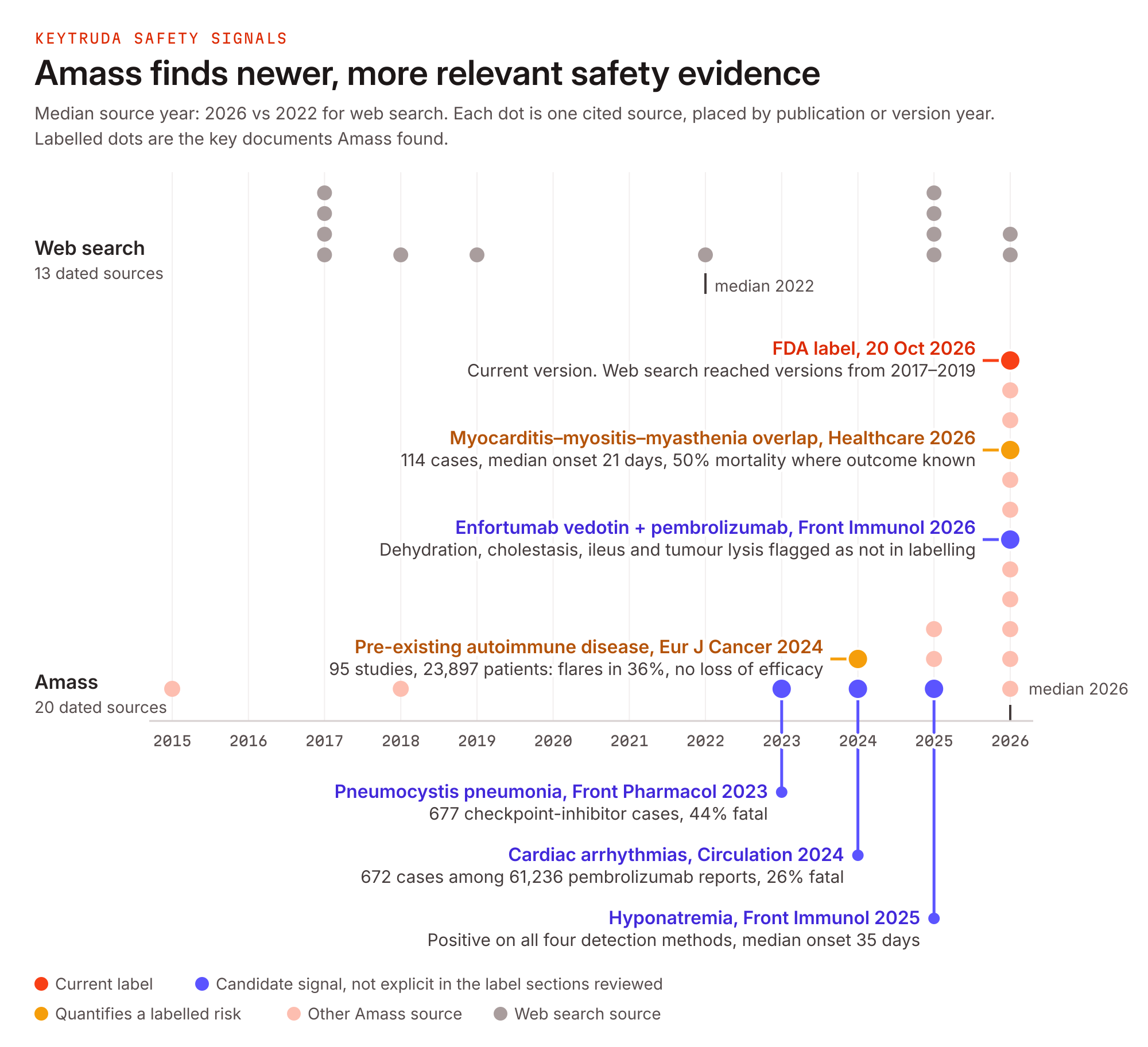
Web search cited four sources from 2017, including an FDA label version and a news article on an FDA alert.
What the current label added
The current FDA label and EU SmPC name risks and monitoring steps that the web search answer missed:
- the myocarditis–myositis–myasthenia gravis overlap syndrome
- cortisol monitoring in neoadjuvant triple-negative breast cancer
- CMV in steroid-refractory colitis, DRESS and Kikuchi lymphadenitis
- early-mortality warnings in NSCLC and colorectal cancer
- the caution for patients aged 75 and over, and the cholangitis risk in biliary tract cancer
With Amass, incidence numbers came from one source: the label's 2800-patient pooled dataset.
With web search, several facts came from secondary sites such as Healthgrades, OptumRx and Quantisnow. Claude also read only portions of long documents such as the EU risk management plan.
Evidence outside the label that Amass found
- Labelled risks with numbers. A 2026 study counts 114 cases of the overlap syndrome. A 2024 meta-analysis covers 23,897 patients with pre-existing autoimmune disease.
- Trial terminations. KEYNOTE-183 and KEYNOTE-185 list their stop reason as "business reasons". In 2017 the FDA placed the myeloma cohorts of KEYNOTE-023 on clinical hold because of safety data from those two trials. Check a registry's stop reason against regulatory actions before you rely on it.
Why connect Amass?
- Current primary documents. RegulatoryCore gives Claude FDA and EMA documents directly, with full section text.
- Linked records. FDA and EMA records are linked, and Claude can search inside a record for specific passages. Claude needed fewer tool calls and got fewer irrelevant results.
- Consistent numbers. Incidence figures come from one dataset.
- Several kinds of evidence in one connector. Claude gets labels from RegulatoryCore, pharmacovigilance literature and real-world evidence from BioMedCore (43M+ citations), and trial terminations from TrialCore (1.2M+ trial records).
Connect Amass to Claude or try Amass free. Read the RegulatoryCore and BioMedCore docs. If your team makes drug safety decisions, get in touch. We'd like to compare notes.
Book a technical discussion