
Product
The new Amass app is live
The largest update to Amass since the app first launched. Ask across all eight *Cores, steer the research as it runs and trace every claim to its source.
- Product
- Feature
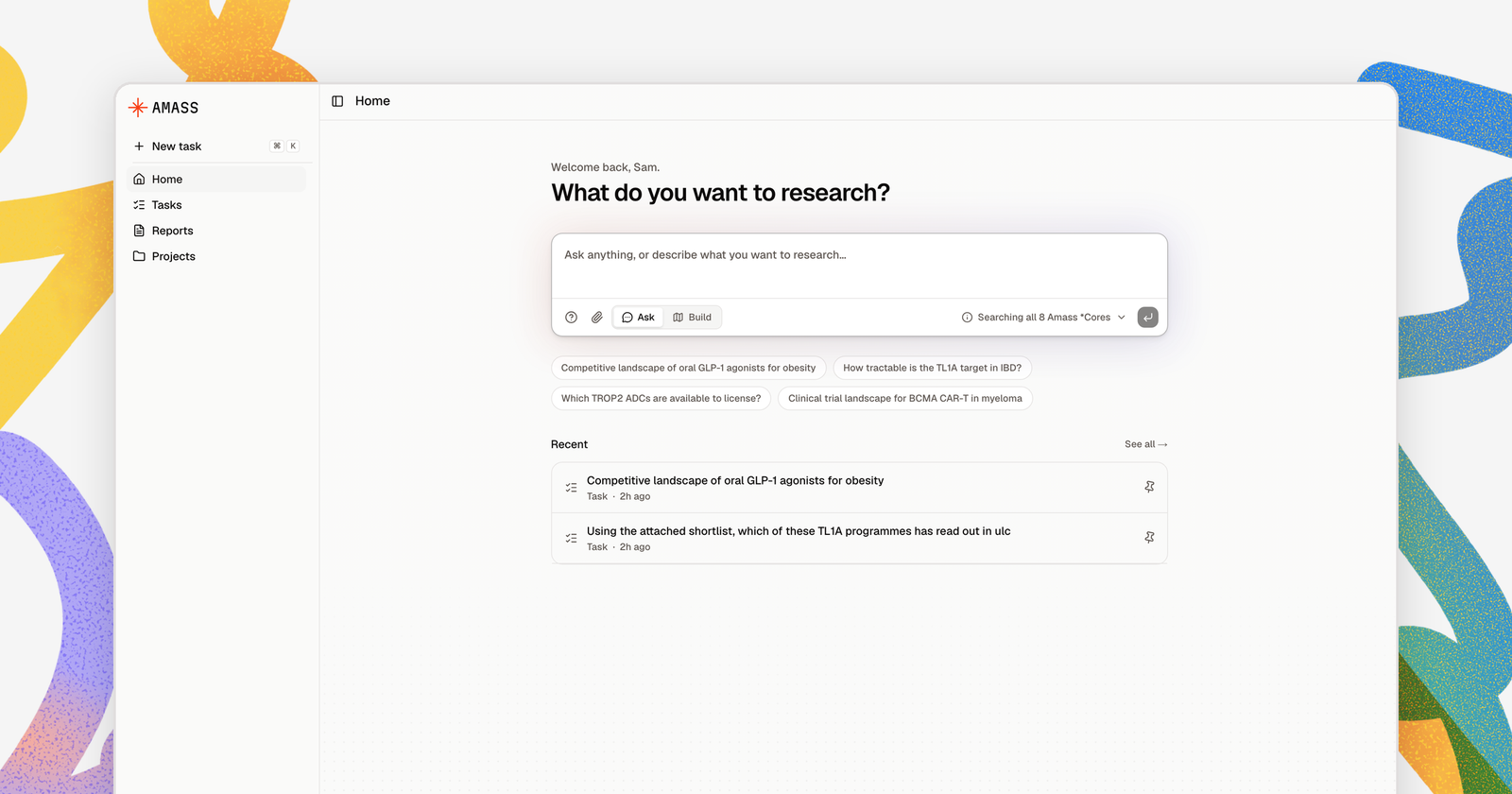
Today, we are launching the largest update to Amass since the app first went live.
At the centre of Amass is our *Core architecture: purpose-built and connected scientific data for literature, trials, patents, regulatory records, drugs, genes and the live web. Curated, harmonized and searched together.
Thousands of people and organizations have used Amass to work across them. That has given us a clear view of how scientific research unfolds in practice. A question develops as the evidence emerges. People move between sources, test a claim from another angle, follow gaps and turn the work into something a team, committee or partner can inspect and act on.
The new app brings the *Cores closer to that process.
From the moment you ask a question, the path through the evidence is visible. You can see how the work is planned, which *Cores are searched, the terms used, what has been reviewed and how each source supports the answer. You can steer the research while it runs, see where the evidence stops and follow every claim back to its source.
Built on the *Core architecture, the app experience has been rebuilt end to end around this way of working, from a single question to a structured report.
Ask a question and watch the research take shape, steer it as it runs, or leave it working in the background. Build a report from a plan you control. See not only the answer, but how it was reached, what was reviewed and where the evidence ends.
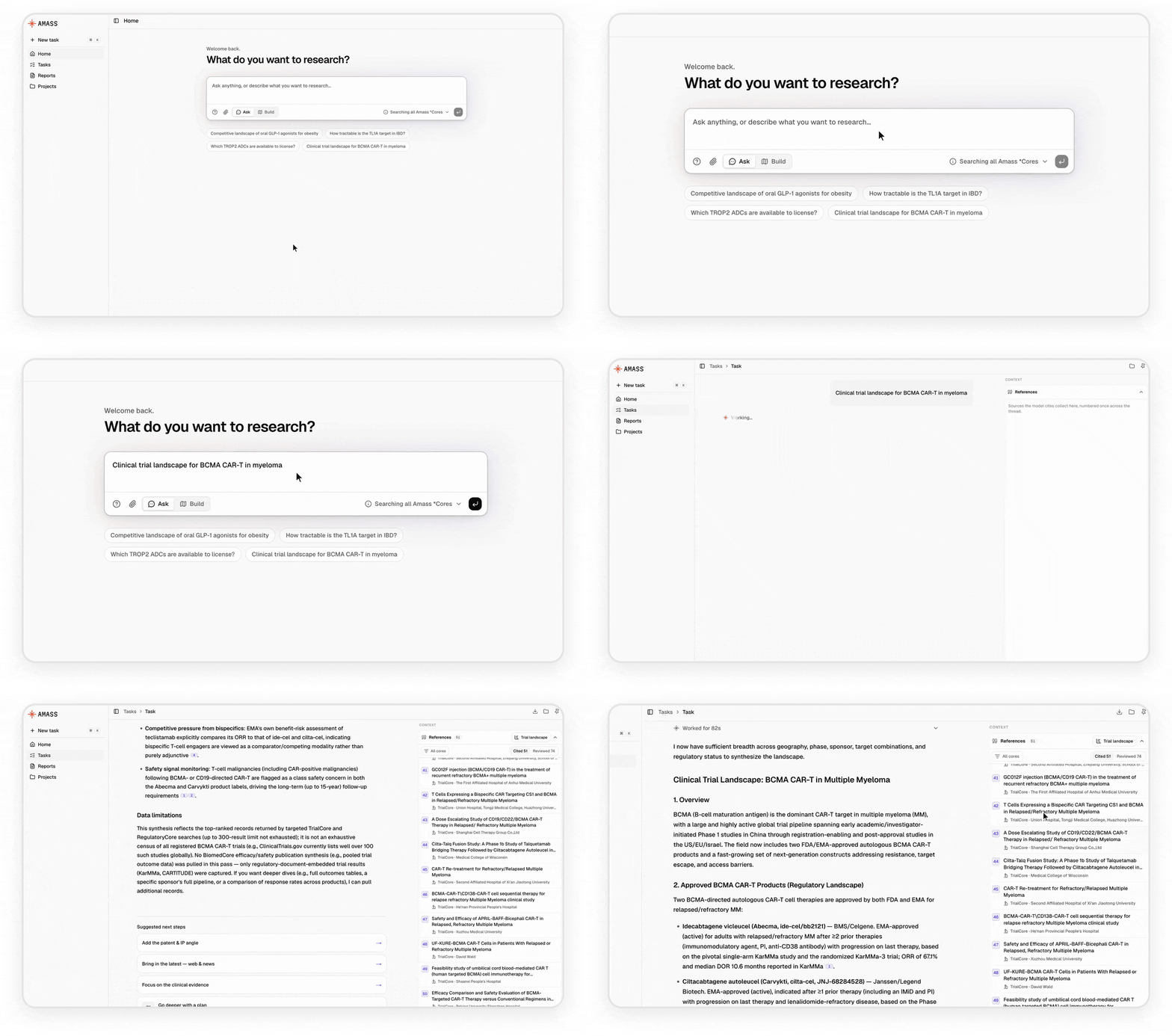
Research you can follow from question to source
The new app is built for questions that need more than a quick response.
You can ask one question across literature, trials, patents, regulatory sources, drug and gene data, and the live web. Amass plans and runs the research in the background, while you watch, steer it or continue with other work. When it is done, you receive a notification.
The process remains visible throughout. You can see how the question is broken down, which *Cores are searched and the search terms used. Every claim in the answer is linked to its source. We call this radical transparency: the answer, the evidence behind it and the limits of that evidence remain connected.
For those who already use Amass, the experience will feel different. The underlying principles have not changed. The new app extends them into a clearer, more capable way to ask, investigate, compare and report.
What you can do in the new app
Ask and steer
- *Ask across all eight Cores. Search literature, trials, patents, regulatory records, drug and gene data, and the live web from a single question.
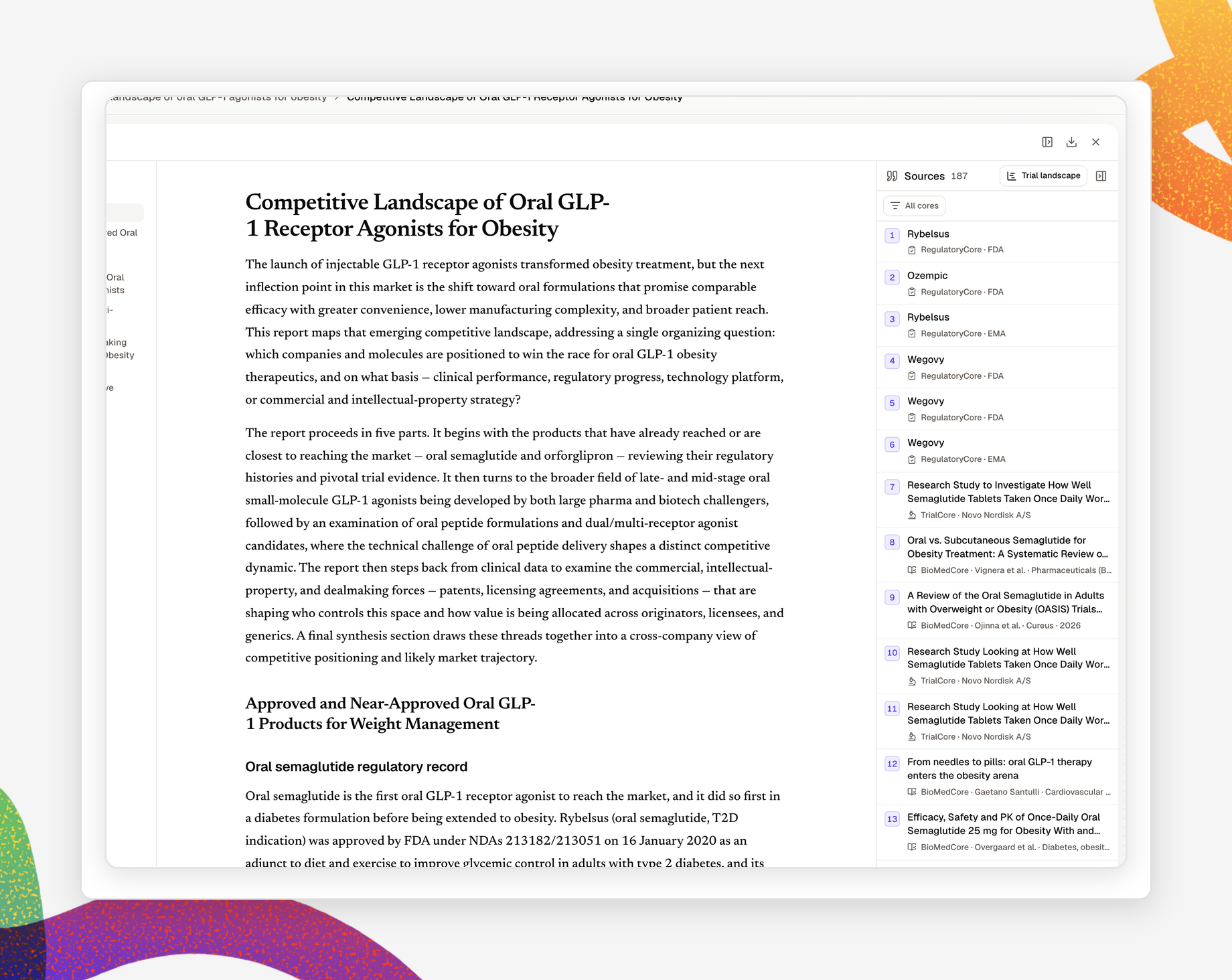
- Start from a built-in example. The home screen includes several, such as the competitive landscape for oral GLP-1 agonists in obesity and the tractability of TL1A in IBD.
- Steer the research while it runs. Each task remains open as a thread. Narrow the question, add context or shift the focus towards patents without starting again.
- See how the work is being done. Follow the question as it is broken into claims, and see which terms are searched against each *Core before the answer is written.
Check the answer
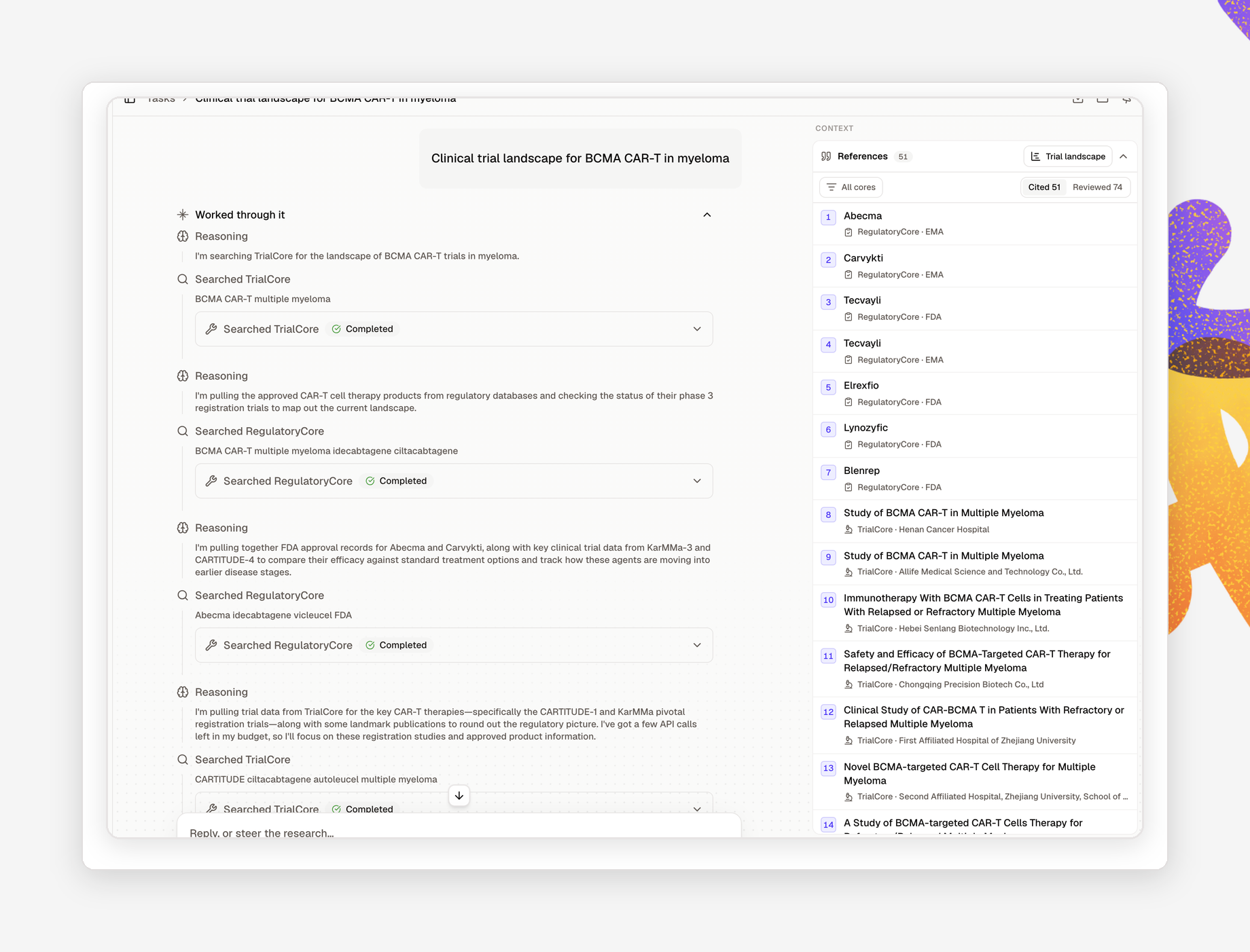
- Trace every claim to its source. Numbered citations connect each claim to a reference panel showing the source *Core and the relevant publication, trial or sponsor details.
- See what was reviewed. A live counter shows how many sources were reviewed and how many were cited. Sources considered but not used remain available for inspection.
- Distinguish an evidence gap from a missing answer. If a search returns no relevant evidence, the app says so and shows what it searched rather than filling the gap by inference.
- Understand the limits. Each answer states what it did not cover and suggests useful next steps.
Compare and visualise
- Build evidence-linked comparison tables. Compare targets, programmes or assets against the criteria you specify. Each cell retains its own citation, and tables can be copied or downloaded.
- Map the trial landscape. View cited trials by phase, sponsor, enrolment and status on a time axis, making it easier to see which programmes are recruiting, completed or discontinued.
Build reports
- Review the plan before the research begins. For larger reports, Amass proposes the sections, the brief for each section and the *Cores it will use.
- Shape the scope before running it. Rewrite a brief, add a freedom-to-operate section, remove what you do not need or change the order.
- Keep completed work together. Reports are collected in a searchable team library and can be filtered by project and author.
- Export directly to PDF.
Work as a team
- Organise work in shared projects. Group related tasks and make the work available to the rest of the team.
- Manage the team in one workspace. Business plans include team management and a pooled allowance.
Keep working while Amass runs
- Run longer tasks in the background. Continue with other work and receive a notification, with optional sound, when the result is ready.
- Choose light, dark or system theme.
- Use Amass beyond the app. The same *Cores are available through the Amass MCP connector in Claude, ChatGPT and Cursor, and through the API.
Ask a question. Get an answer you can check.
Ask how tractable a target is, which programmes in an indication remain active, how far they have progressed or where the competitive landscape is moving.
Amass searches the relevant literature, clinical trials, patents, regulatory records and other *Cores together. It then returns a synthesis in which every claim links to the source behind it.
If the evidence is not there, Amass says so and shows what it searched. That distinction matters. No registered trial is a finding; failing to find a registered trial is not. They should not lead to the same decision.
The research process remains visible while the task runs. You can follow the question as it is split into separate claims, inspect the searches made against each *Core and compare the sources reviewed with those ultimately cited. The sources that were read but not cited remain part of the trail.
Each task stays open as a thread, so you can ask follow-up questions and steer the work without losing what came before.
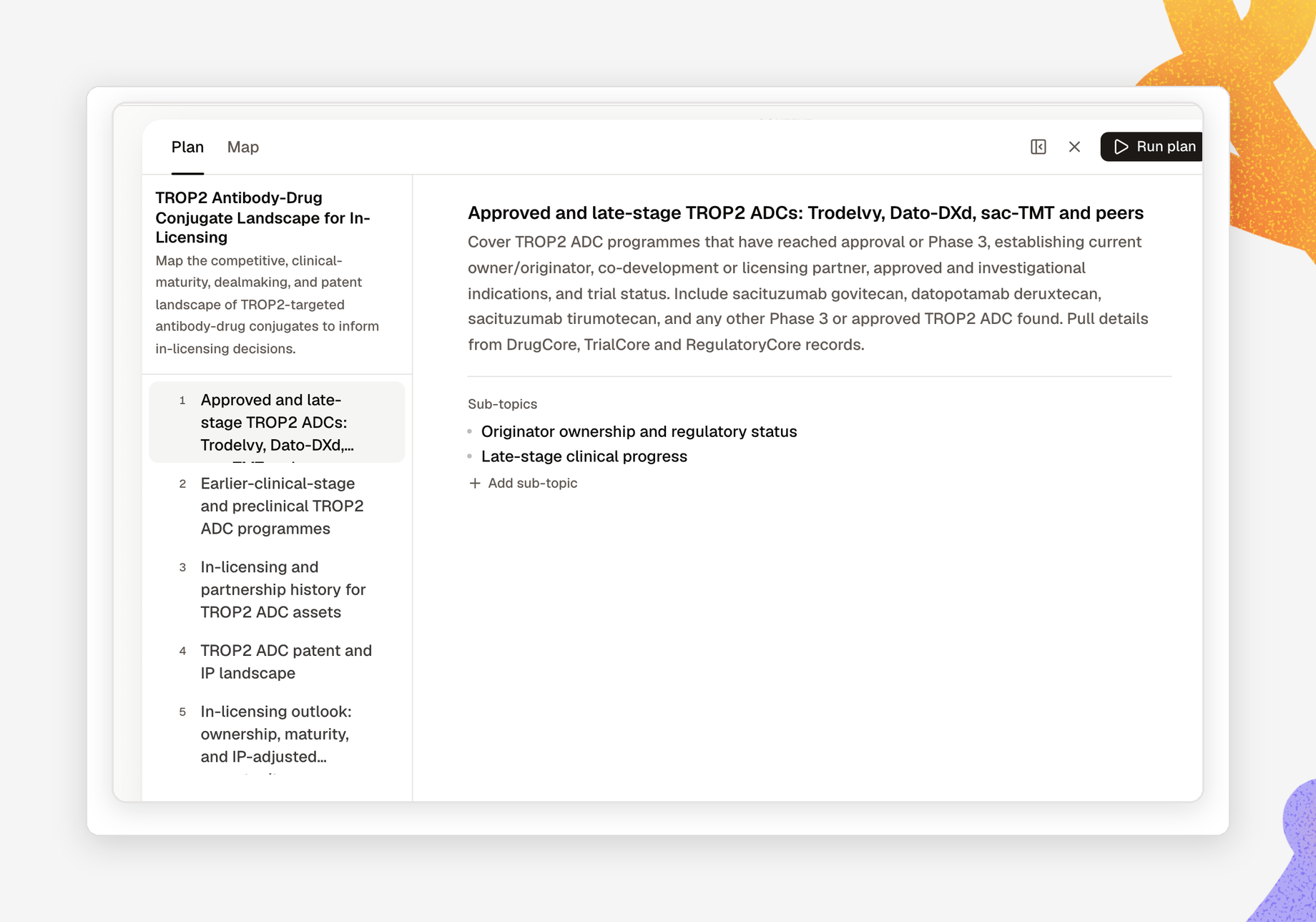
From question to report
For larger assignments, the app plans the work before it begins.
Ask for a TROP2 antibody-drug conjugate landscape for an in-licensing decision, covering programme ownership, development status and the patent position. Amass first proposes the report structure, the brief for each section and the *Cores it intends to search.
You can review the plan before the research runs: rewrite a brief, add a section on freedom to operate, remove sections you do not need or change their order. The work begins when you press Run.
The result is a structured report with claim-level citations. It is saved alongside your team's other reports, with its author and project, and can be exported directly to PDF.
The architecture and data underneath it
The new experience runs on an expanded version of the same *Core architecture that powers Amass. *Cores are Amass's purpose-built scientific databases. They are curated, cross-linked and searched together, connecting records such as a paper, the trial that tested the underlying hypothesis, the molecule involved and its regulatory label.
- BiomedCore: 40M+ biomedical publications from PubMed and PMC
- ScholarCore: 233M+ papers, preprints and conference proceedings
- PatentCore: 170M+ patent documents from major patent offices worldwide
- TrialCore: 1.2M+ clinical trials from ClinicalTrials.gov and WHO ICTRP
- RegulatoryCore: FDA and EMA approvals, labels, SmPCs and reviews
- DrugCore: 22K+ molecules, harmonised on ChEMBL
- GeneCore: 43K+ genes, with druggability and safety context
- WebCore: real-time web sources, including company sites, press releases and conference news
Start free
The new app starts with a free plan, so you can use it on your own questions and hypotheses before choosing a paid plan.
Basic is $9 per month for running more scientific work. Standard is $39 per month for professionals. Business is $499 per month for teams working in a shared workspace.
Already using Amass?
Nothing changes for existing users today. The app you know remains available, along with your existing work. You can move to the new experience when you are ready, while new users will start there from today.
The new app is built for evidence-heavy work from early discovery through clinical development, and for the licensing, investment and portfolio decisions that depend on it. In each case, the value of a faster answer depends on being able to show how you got there.
It gives every research task more reach, more structure and a clearer path back to the underlying evidence, and it gives us the foundation for what comes next.
We would like you to try it on a real question and tell us what you think.