
Customer
Four students built Trial, a research agent that holds back on thin evidence
Made at the London AI x Science Hackathon, Trial links each claim to its source and calls an answer established only when no evidence gap is left open.
- Customer
- API
- Use Case
Dami Ogunleye, Mikhail Rudchenko, Omar Sayed and Charlie Piper built Trial, a research agent that has to show its work, at the London AI x Science Hackathon on 3 and 4 October 2026. Every claim points to the passage it came from, an independent model checks the evidence before the agent answers, and the agent may only be as certain as the evidence allows.
All four are in their final year, writing dissertations, and often ask research agents for help. They kept seeing an agent report that it had checked everything and found nothing to support a claim, without having searched exhaustively.
"We found that there was a flaw with how research agents conduct the research, because oftentimes they will state conclusions very confidently without being 100% sure or without being 100% exhaustive. [...] If we take this blindly and just go ahead, then we might end up wasting a bunch of time doing something that has already been done."
Omar Sayed, Trial
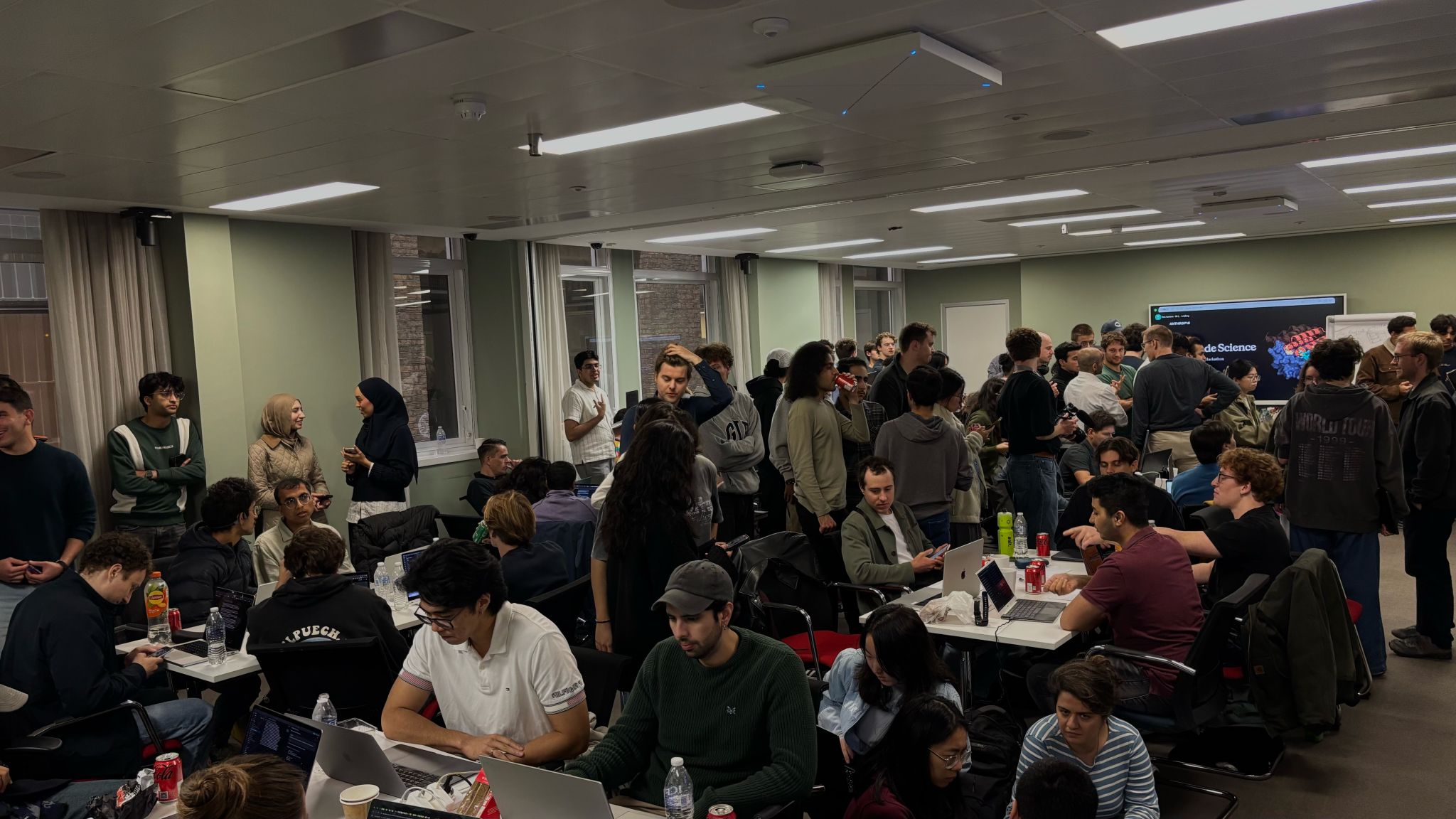
The team
Dami, Mikhail and Omar are fourth-year robotics and AI students at UCL. Charlie studies computer science and AI at the University of York, and met Dami over the summer on the Google DeepMind Research Ready program in York. The four teamed up for the hackathon and entered Track 2, Originator's track for agents that do science and know when they are wrong.
They spent a long time choosing the idea before writing any code. "By the time we actually knew what we were going to work on, it was kind of smooth sailing, because we weren't fighting over ideas towards the end," Charlie says.
How Trial works
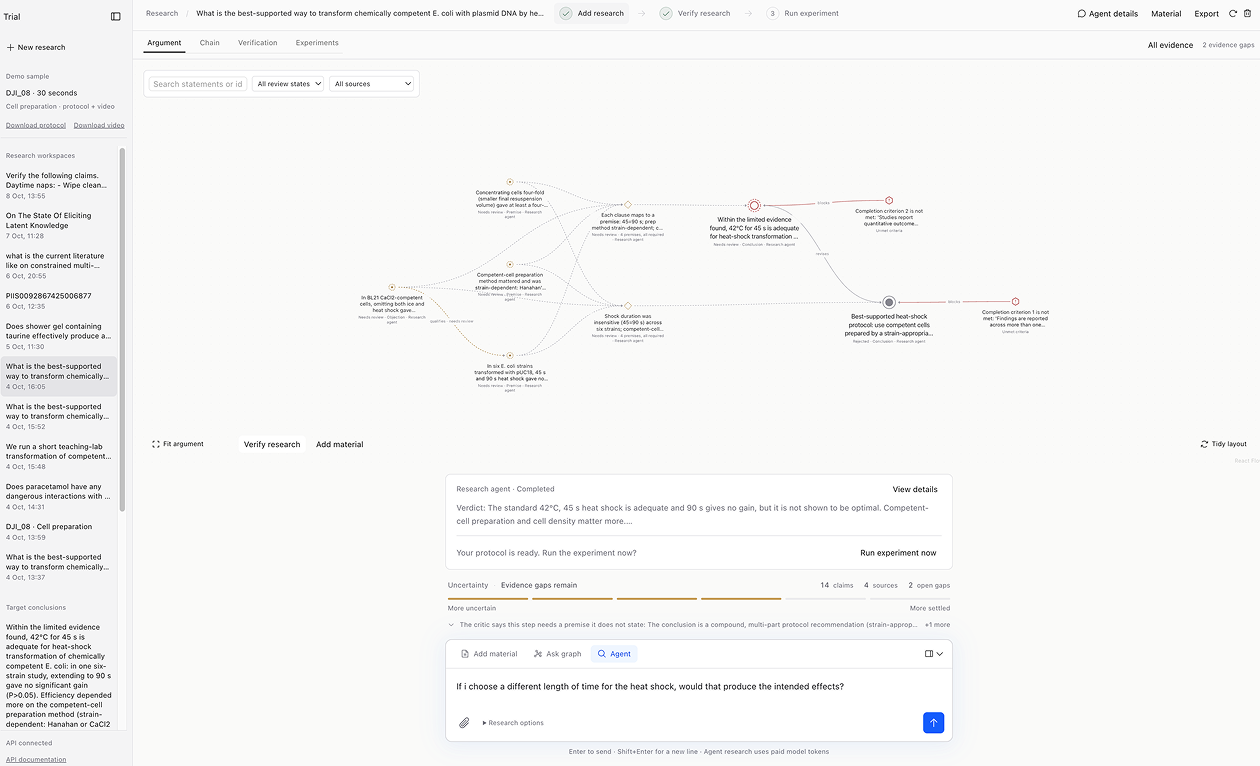
Trial turns papers into an argument graph, where each claim links to the passage it came from and each conclusion to the premises behind it. You can add papers yourself, or give the agent a question, a claim or a hypothesis and watch it search, read, record claims and change its mind.
Before the agent answers, fixed checks look for missing evidence, missing premises, causal claims made without the right study design, conflicts between sources, and retracted papers. Then the guard, an independent model, reads only the passages the agent cited and decides whether criteria set before the research are met. The agent may call an answer "established" only when nothing is left open. Otherwise it says "conditional" or "hypothesis", or it abstains, and it gives its certainty in words, never as a percentage.
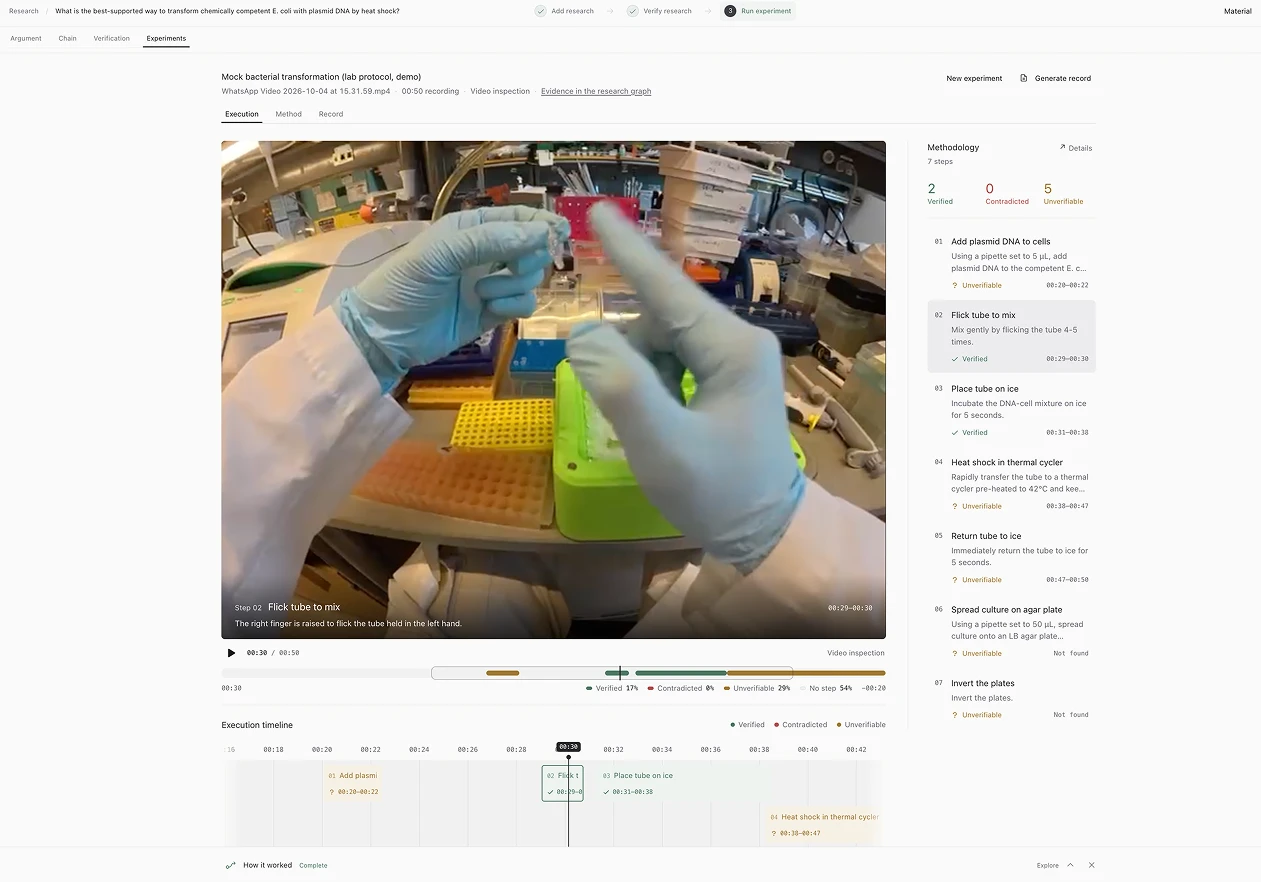
Alongside the agent, a second stream turns the protocol a paper describes into a step-by-step procedure. Computer vision then follows the experiment live, or from a recorded video, and flags any issues. "Because we had both things working in parallel, we were able to create a product that was very holistic for the whole research experience," Dami says.
Results and limits
To see whether the guard is worth its cost, the team ran Claude Sonnet 5.5 with and without it on the same questions, each in a fresh workspace with only the source text. Every answer was scored claim by claim against the source, so a longer answer earned nothing for its length.
| Without the guard | With the guard | |
|---|---|---|
| Errors per answer, 30 questions on full-text papers | 1.27 | 0.60 |
| False statements about the source, same questions | 0.60 | 0.17 |
| Correct verdicts, 60 SciFact claims with expert labels | 90% | 90% |
| Unsupported claims per answer, same SciFact claims | 0.35 | 0.07 |
The guard roughly halved the errors without getting more verdicts wrong, at three to four times the cost per answer. The team's first evaluation said the opposite, because it had shown the agents the answer key by accident and rewarded long answers. The figures are from the project's README, read on 28 October 2026. The evaluation was small, because a hackathon leaves little time or credit for one. Since then the team has made several improvements to cut costs and improve performance, and aims to build a more thorough evaluation framework.
Verification, the README notes, means the checks ran and the gaps are listed; it does not mean the claim is true. The guard is a language model too. The 30 questions cover six papers and are scored by a model, and only the SciFact labels come from experts. Scanned PDFs need OCR, which Trial does not do yet.
Since the hackathon
When we spoke at the end of October, Omar said they had made Trial more reproducible and reliable and added features they had no time for during the hackathon. They hope to take it further.
Mikhail has been running it on claims from everyday life. One was a shower gel's claim that its taurine gives you a boost, and Mikhail reports the agent found nothing in the literature to support it. Mikhail also showed Trial to someone at a genomics startup, who said a tool like it would be useful to them.
Omar says: "It would be nice if people can test it out and maybe reach out to us if they have any feedback or questions." Trial is at trial.misharuko.com, and the team's demo is on YouTube.
Where Amass helped
| What the team used | What for |
|---|---|
| BioMedCore search, through the Amass API | Searching 43M+ papers from PubMed and PubMed Central for the user's question |
| Full text | Importing a paper as a source in the argument graph |
| The retraction flag | Marking a retracted paper as an invalid source, so no answer resting on it can be called "established" |
| The platform docs | Dami had Claude go through them to see what each *Core returns, before the team settled on the idea |
Asked whether anything surprised them when using Amass, Mikhail said: "There were no bad surprises. [...] It was just smooth, I guess. And that's a good thing. I think probably the absence of bad news is good news."
About the hackathon
The London AI x Science Hackathon ran on 3 and 4 October 2026, organized by Iterate and Future.bio as part of London Deep Tech Week. Teams of three to five had 48 hours across four tracks: open math problems, agents that do science and know when they are wrong, protein engineering, and materials manufacturing. The organizers list 50 submitted projects.
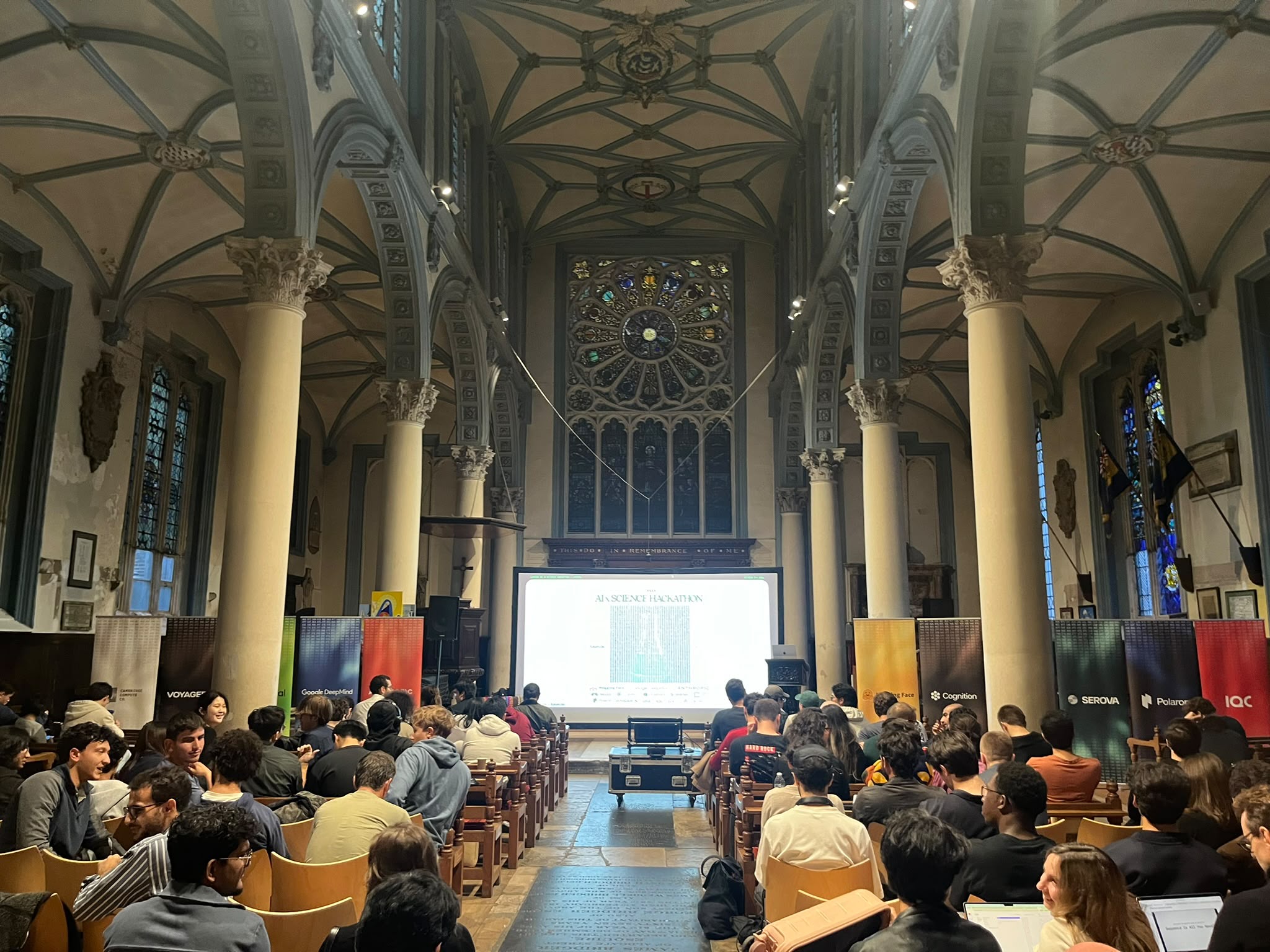
Sponsors included Anthropic, Hugging Face, Google DeepMind, Voyager Ventures, Originator, Cambridge Compute Co, Modal, Serova, Cognition, Polaron, GXL, IQC, AIDDA, Pillar and Amass.
If you are building an agent that has to know when the evidence is not there, tell us what you are working on.
Book a technical discussion