

Skill
ORCID record self-verify
Paste your own ORCID; get the publication record Amass indexes under that verified identity, screened in one pass for retractions, below-peer-review journals, and trial linkage — a clean integrity self-audit before a grant, tenure, or promotion submission.
New to Amass? Connect Amass to Claude first
The prompt
Paste this into Claude
0000-0003-3118-6859 (illustrative public stand-in for 'your ORCID')Use the ORCID record self-verify skill.
Your ORCID: 0000-0003-3118-6859Why not just ask the model?
Ask a plain model to "list the papers under ORCID 0000-0003-3118-6859 and flag any retractions" and it either refuses or invents a plausible-looking bibliography — fabricated PMIDs, journals, years, and retraction claims it cannot ground.
- Plain model: invented citations under a name it can't verify, and a retraction verdict with nothing behind it — exactly the kind of unchecked claim you don't want feeding a grant or tenure packet.
- Amass: the records actually indexed under that verified identity via the
authorOrcidsfilter — a hard ORCID identity key, not a fuzzy name string — each carrying first-classisRetractedandjournalQualityJufofields, plus thereferencesTrialCoreedge read per record to flag any paper linked to a clinical trial.
Why a skill, not a prompt?
This is a multi-step orchestration, not a single question: one identity-filtered BiomedCore search to pull the record, then a get_amass_biomedcore_record per returned paper to read the referencesTrialCore edge (search payloads omit it), then a client-side three-dimension screen (retracted / below-peer-review JuFo / trial-linked) rolled into a partition column and a one-line verdict. Packaging it as a skill means you trigger the whole sequence with one line and carry the sample caveat and field-grounding guardrail into every run, instead of re-pasting a brittle procedure.
Honest scope
The authorOrcids filter is an ANY-author match — a row qualifies if at least one author carries the ORCID, and the projection does not name which author matched, so confirm the ORCID-holder in each author list. The 10 results are a relevance-ranked sample, not a census of the full indexed record — search returns no total at any limit; broaden by raising limit (up to 50) or unioning a second query wording, and export a fuller record over the REST API, whose limit goes to 300. Fields are verbatim from Amass as indexed and can lag the live registry.
Install the skill
Add the skill to Claude
Install every Amass skill with one command, npx skills add amass-technologies/public-skills or download the SKILL.md from GitHub and add it to Claude (Settings → Capabilities → Skills, or drop it in your Claude Code skills directory). Then paste the prompt above to trigger it.
More from the library
Keep exploring
| Short name | Source id | Registry | Copy of |
|---|---|---|---|
| Acute, 50/75 mg vs placebo | NCT04072354 | ClinicalTrials.gov | |
| ↳ EUCTR2019-000470-36-BG | EU CTR | NCT04072354 | |
| Acute, 75/100 mg vs placebo | NCT04092686 | ClinicalTrials.gov |
Watchlist Monitor
Name the trials, papers, approvals or drugs you need to follow; get one Excel board that re-reads them through Amass at every check and tells you exactly what changed: status, dates, enrollment, results posted, label revisions, retractions, new links.
Landscape Monitor
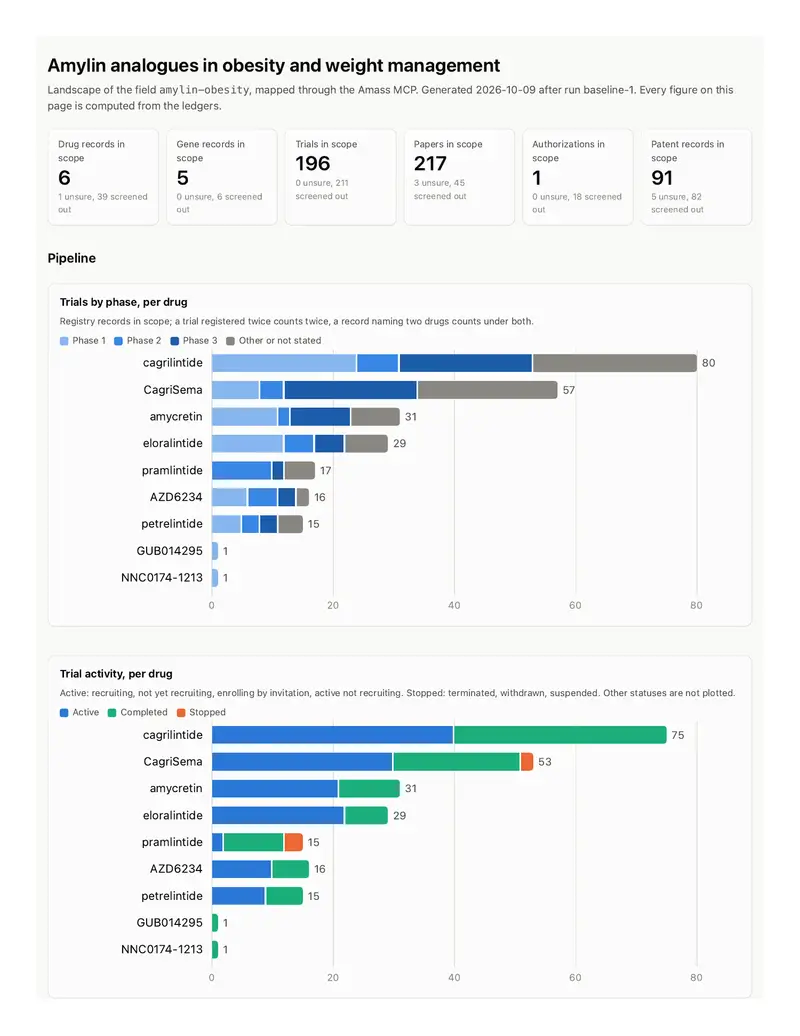
Name a field; get it mapped across trials, papers, patents, drugs, genes and approvals into a landscape page with charts, a workbook and a one-page briefing, every record screened with its reason. Ask for an update later to see what is new and what changed.
| kinase | kinase_family_chembl_leaf | small_molecule_tractability | protac_tractability |
|---|---|---|---|
| PLK1 | Other protein kinase PLK family | Advanced Clinical | predictive-only |
| WEE1 | Other protein kinase WEE family | Advanced Clinical | predictive-only |
| CDK1 | CMGC protein kinase CDK5 subfamily | Advanced Clinical | predictive-only |
Target prioritization matrix
A general, interview-driven target-discovery workbench: name the biology and the modality you care about, and get back a scored table of candidate targets — druggability, essentiality, genetic constraint, curated safety, and the real number of drugs already targeting each — assembled from GeneCore intelligence and DrugCore/TrialCore/BiomedCore/PatentCore cross-links.
Run it yourself
Connect Amass to Claude and paste the prompt.
The connector takes about a minute to add, then this workflow runs on your own inputs.
- Data
- No training on your data
- Hosting
- EU-hosted, enterprise
- Isolation
- Tenant-isolated by architecture
- Certification
- ISO 27001, SOC 2, NIS2: in motion