

Prompt
Retraction hotspot scan
Name a research topic; get a checkable, downloadable list of the retracted papers Amass indexes on it — ranked by citation reach, with strict no-reason guardrails.
New to Amass? Connect Amass to Claude first
The prompt
Paste this into Claude
stem cell therapy regenerative medicineTOPIC: stem cell therapy regenerative medicine
You have the Amass MCP connected (BiomedCore + TrialCore). Run a RETRACTION HOTSPOT SCAN
on the TOPIC above, for a journal/publisher research-integrity screen.
1. Call search_amass_biomedcore_records with:
query = the TOPIC verbatim (strip any punctuation/operators — Amass is bag-of-tokens,
no AND/OR/quotes; pick dense, distinguishing terms)
isRetracted = true
This returns up to `limit` papers that Amass flags as RETRACTED on this topic — `limit` is
1–50 and defaults to 10, which is what this scan uses.
2. Build a table of every returned record, sorted by citationCount DESCENDING, with columns:
Rank | Title (verbatim, unmodified) | Journal | Year | Citations | JuFo tier | PMID | Amass ID
Then output the same table as a downloadable CSV.
3. GUARDRAILS — this is a MEDIUM-stakes integrity workflow. Obey exactly:
- Report only the field-level facts Amass returns: the `isRetracted = true` boolean,
the unmodified title, journal, year, citationCount, journalQualityJufo, PMID, Amass ID.
- Amass exposes NO retraction-reason field. Do NOT infer or state *why* a paper was
retracted. Never write "fraud", "misconduct", "fabrication", "plagiarism", "error",
or impute intent. The only claim you may make about a row is: "flagged
isRetracted = true in Amass as of <today's date>."
- The search returns at most `limit` results (10 here) and no total count. State explicitly
that this is a "top-10 sample by relevance, NOT an exhaustive census of retractions on the
topic."
- SPARSE-TOPIC CAVEAT: if the topic is narrow or its tokens are uncommon, an
isRetracted=true search can fall back to off-topic retractions that merely share a
token. Before trusting the list, sanity-check that each returned title is actually on
the topic; flag and drop any that are not, and warn the reader that sparse topics
degrade this way. (Dense topics like the example stay on-topic.)
4. Close with a one-line verdict, e.g.: "Amass flags N retracted papers on '<topic>' in this
top-10 sample (as of <date>); highest-cited: <title> (<citations> citations, PMID <pmid>)."Why not just ask the model?
Ask a plain model "which papers on stem-cell therapy were retracted?" and it confidently invents plausible titles, journals, and PMIDs — retraction status is exactly the kind of fact a model fabricates.
- Plain model: invented titles, journals and PMIDs; guessed (often defamatory) "reasons."
- Amass: a server-side
isRetracted=truefilter over a real index — 10 genuinely retracted papers ranked by citation reach (the MSC-exosome review still cited 201× after retraction, PMID 34253242), each a checkable record, with no inferred reason.
Honest scope
A top-10 relevance sample, not an exhaustive census (the search returns no total count). Each
row claims exactly one thing — flagged isRetracted=true in Amass as of the run date; Amass exposes
no retraction-reason field, so nothing here states why a paper was retracted. Sparse topics can
surface off-topic retractions that merely share a token — eyeball the titles before trusting the list.
More from the library
Keep exploring
| Short name | Source id | Registry | Copy of |
|---|---|---|---|
| Acute, 50/75 mg vs placebo | NCT04072354 | ClinicalTrials.gov | |
| ↳ EUCTR2019-000470-36-BG | EU CTR | NCT04072354 | |
| Acute, 75/100 mg vs placebo | NCT04092686 | ClinicalTrials.gov |
Watchlist Monitor
Name the trials, papers, approvals or drugs you need to follow; get one Excel board that re-reads them through Amass at every check and tells you exactly what changed: status, dates, enrollment, results posted, label revisions, retractions, new links.
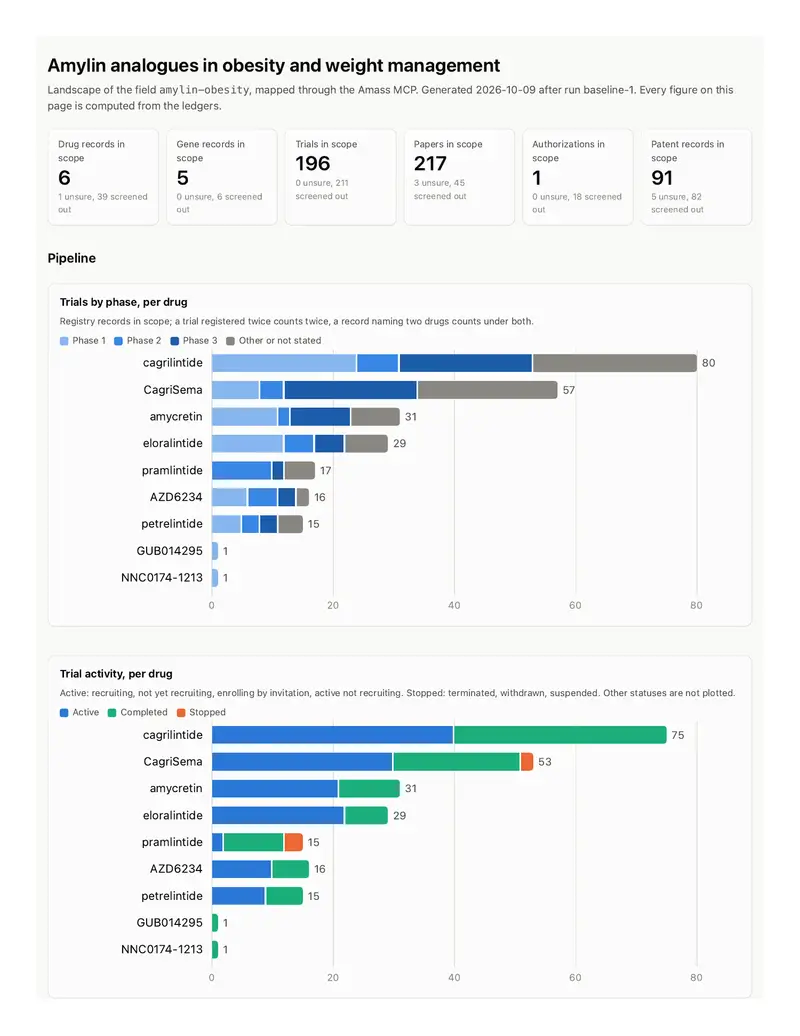
Landscape Monitor
Name a field; get it mapped across trials, papers, patents, drugs, genes and approvals into a landscape page with charts, a workbook and a one-page briefing, every record screened with its reason. Ask for an update later to see what is new and what changed.
| kinase | kinase_family_chembl_leaf | small_molecule_tractability | protac_tractability |
|---|---|---|---|
| PLK1 | Other protein kinase PLK family | Advanced Clinical | predictive-only |
| WEE1 | Other protein kinase WEE family | Advanced Clinical | predictive-only |
| CDK1 | CMGC protein kinase CDK5 subfamily | Advanced Clinical | predictive-only |
Target prioritization matrix
A general, interview-driven target-discovery workbench: name the biology and the modality you care about, and get back a scored table of candidate targets — druggability, essentiality, genetic constraint, curated safety, and the real number of drugs already targeting each — assembled from GeneCore intelligence and DrugCore/TrialCore/BiomedCore/PatentCore cross-links.
Run it yourself
Connect Amass to Claude and paste the prompt.
The connector takes about a minute to add, then this workflow runs on your own inputs.
- Data
- No training on your data
- Hosting
- EU-hosted, enterprise
- Isolation
- Tenant-isolated by architecture
- Certification
- ISO 27001, SOC 2, NIS2: in motion