

Prompt
Trust-filtered grounded answer
Ask a clinical question; get an answer where every sentence is pinned to a high-quality, non-retracted paper — and anything the evidence can't support is refused, not fabricated.
New to Amass? Connect Amass to Claude first
The prompt
Paste this into Claude
lecanemab efficacy and ARIA risk in early Alzheimer'sQUESTION: What does high-quality, non-retracted evidence say about lecanemab's efficacy and
ARIA risk in early Alzheimer's disease?
You have the Amass MCP connected (BiomedCore). Answer the QUESTION, but make every sentence
TRACEABLE — and refuse anything you cannot ground.
1. Pull a trust-filtered corpus. Call search_amass_biomedcore_records with:
query = the key clinical terms from the QUESTION (strip punctuation/operators)
minJournalQualityJufo = 2
isRetracted = false
(add minPublicationDate if the question implies recency). This returns up to `limit`
domain-leading, non-retracted papers, each with an abstract — `limit` is 1–50 and defaults
to the 10 this prompt uses.
2. Write the answer as a short list of CLAIM sentences. For EACH claim, it must be grounded in a
specific returned abstract. Build a PER-CLAIM PROVENANCE TABLE with columns:
Claim | Status | Source PMID | Journal | JuFo | Citations | Retracted? | Basis (abstract snippet)
"Basis" must quote or closely track the abstract sentence that supports the claim. Numbers
(percentages, hazard ratios, durations) must appear verbatim in that abstract — never rounded
from memory, never invented.
3. REFUSE, don't guess. If a sub-question cannot be grounded in any returned JuFo>=2 abstract,
add a row with Status = REFUSED and a Basis that says why (e.g. "no returned high-quality
abstract reports this outcome"). If the high-quality evidence CONTRADICTS a premise in the
question, mark Status = REFUSED (contradicted) and cite the contradicting record. Do NOT fill
refused rows with plausible-sounding numbers.
4. NEGATIVE CONTROL (always include). Append two deliberately ungroundable sub-questions for this
topic and show them being refused — e.g. a long-horizon outcome the trials never measured, and
a stronger claim than the evidence supports (cure/reversal vs slowing). This demonstrates that
the answer refuses rather than over-answers.
5. Then write the prose answer using ONLY the GROUNDED claims, each tagged with its PMID. End with:
"Grounded claims: N. Refused (ungrounded/contradicted): M. Every grounded number above appears
verbatim in the cited abstract; nothing was filled in from memory." Output the provenance
table as a CSV.Why not just ask the model?
A plain model answers a clinical question fluently and quietly invents the specifics — an ARIA-E rate, an APOE-homozygote risk, a hazard ratio — with no source and no quality gate.
- Plain model: fluent prose, fabricated numbers, no provenance, no refusals.
- Amass: a JuFo≥2, non-retracted corpus where every claim is pinned to an abstract — the ≈5-month slowing of decline (PMID 37295957), the 13.6% ARIA-E rate and 34.5% in APOE ε4 homozygotes (PMID 38730496) — and anything the corpus can't support is refused, not guessed.
Honest scope
The corpus is the top-10 JuFo≥2, non-retracted papers Amass returns for the query — a trust-gated sample, not an exhaustive review. Every claim is grounded in a returned abstract; a sub-question the corpus can't support is refused, not filled in. It grounds and cites clinical evidence; it is not medical advice, and a refusal marks where high-quality evidence is silent.
More from the library
Keep exploring
| Short name | Source id | Registry | Copy of |
|---|---|---|---|
| Acute, 50/75 mg vs placebo | NCT04072354 | ClinicalTrials.gov | |
| ↳ EUCTR2019-000470-36-BG | EU CTR | NCT04072354 | |
| Acute, 75/100 mg vs placebo | NCT04092686 | ClinicalTrials.gov |
Watchlist Monitor
Name the trials, papers, approvals or drugs you need to follow; get one Excel board that re-reads them through Amass at every check and tells you exactly what changed: status, dates, enrollment, results posted, label revisions, retractions, new links.
Landscape Monitor
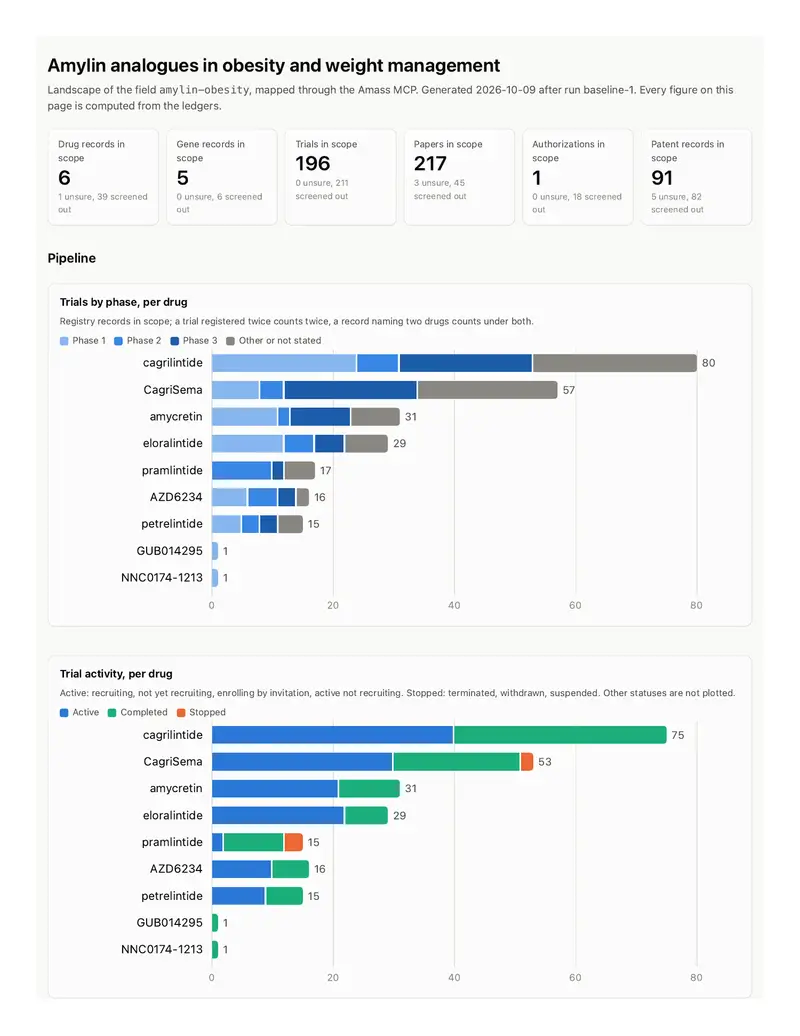
Name a field; get it mapped across trials, papers, patents, drugs, genes and approvals into a landscape page with charts, a workbook and a one-page briefing, every record screened with its reason. Ask for an update later to see what is new and what changed.
| kinase | kinase_family_chembl_leaf | small_molecule_tractability | protac_tractability |
|---|---|---|---|
| PLK1 | Other protein kinase PLK family | Advanced Clinical | predictive-only |
| WEE1 | Other protein kinase WEE family | Advanced Clinical | predictive-only |
| CDK1 | CMGC protein kinase CDK5 subfamily | Advanced Clinical | predictive-only |
Target prioritization matrix
A general, interview-driven target-discovery workbench: name the biology and the modality you care about, and get back a scored table of candidate targets — druggability, essentiality, genetic constraint, curated safety, and the real number of drugs already targeting each — assembled from GeneCore intelligence and DrugCore/TrialCore/BiomedCore/PatentCore cross-links.
Run it yourself
Connect Amass to Claude and paste the prompt.
The connector takes about a minute to add, then this workflow runs on your own inputs.
- Data
- No training on your data
- Hosting
- EU-hosted, enterprise
- Isolation
- Tenant-isolated by architecture
- Certification
- ISO 27001, SOC 2, NIS2: in motion